


How Does Your Internet Speed Measure Up?
When your Internet seems sluggish, you might be wondering “How fast is my internet speed?” or “Why is my internet slow?” These are common questions, and there are quite a few definitions of internet speed, as well as several free ways to test it. Here's the scoop on Internet speed tests, and why you definitely should check your speed every once in a while. Read on... |
What is My Internet Speed?
By "internet speed" most people mean, "how fast I can download things" like web pages, music, videos, software, etc. Internet service providers tune their connections so that most of their available bandwidth is devoted to downloading and far less to uploading (sending) things. ISPs do this because a) they know fast downloads are of greater importance to most consumers, and b) they want to discourage people from running high-traffic business Web sites from their consumer priced accounts.
When uploading or downloading, the Internet can be "bursty" at times. That means your file transfer may go very fast one instant and very slowly the next. "Download speed" is generally measured as an average, dividing the time it takes to transfer a file of a given size into the file size. If it takes 1 second to transfer a file of 1 MB, your Net speed is 1 MB/s at that particular time, and between the two particular points.
If you have a DSL connection, your max download speed will be somewhere between 1.5 - 30 Mb/s. Most cable internet connections will be in the 20-100 Mb/s range, and a fiber optic connection will typically get you between 200 and 400 Mb/s. Some providers are offering “gigabit” service, which is 1000 Mb/s. Higher speeds may be available in each type of service, and will usually correspond to a higher price point.
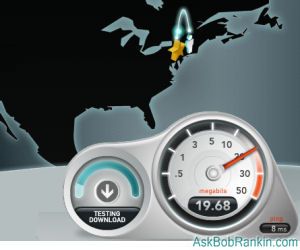
Internet speed is not something you can measure and take for granted forever thereafter. Internet traffic may be heavier between different points and between the same points at different times. Local outages on the Internet may force traffic to take detours, lengthening their trips and slowing Net speed temporarily. It's just like a real road system.
Here's another good reason to occasionally run an internet speed test. Your ISP may throttle your internet speed without telling you. At my previous home, I had Verizon FIOS for Internet service, and I was supposed to get a 50Mb/s download speed. But on two occasions, I ran a speed test and found that it was mysteriously maxing out at 10Mb/s. When I contacted Verizon, they made some lame excuses, and set me back to the higher speed. So run a speed test every once in a while, and make sure you're getting the level of service you're paying for.
How To Test Your Internet Speed
Now that you understand that there is no cut-and-dried, final "knowing" of your internet speed, let's look at a few ways to measure it.
Speakeasy and Speedtest.net are two of the most popular Net speed testing sites online. Both have been around for over a decade, and have evolved with changing technology. But using either is simple. At Speakeasy, you'll have a choice of testing the connection speed between your location and several cities scattered across the USA. I live close to New York City, and my download speed for that test is consistently at 310 Mb/sec. But as I look westward, it slows down. Downloading from Los Angeles, for example, shows 256Mb/sec.
SpeedTest gives you a choice of several servers to test locally, with the option to select from servers all over the world. Just click the "GO" button and watch the odometers spin up. I was rather surprised that when I selected Oslo, Norway as my test site, I got almost exactly the same download speed result as with New York City. SpeedTest is a nice tool, but just be careful that you don't accidentally click one of the ads instead of running the speed test. Speedtest also offers a Speedtest Global Index page, which shows average speeds for both mobile and fixed broadband connections around the world. (Spoiler alert: Head to Singapore, Chile, or Thailand if broadband speed is your top priority. You'll find the fastest mobile data speeds in the UAE, Norway, and South Korea.)
Download speed is the rate at which a file of known size was transferred from the test site to your computer. It depends on the location of the test site selected; the amount of traffic on the route between you and the test site; the traffic load on the test site at the time of your test; and so on. But it's a number.
Upload speed is the same as download speed, in reverse. A file of known size is generated temporarily on your computer and transferred to the test site. The same caveats apply.
Ping is a significant number that most users don't understand. It's more accurately described as "latency," or the delay between sending a request for data to a remote computer and receiving a reply. The Ping speed reported by Speedtest.net is the sum of the latencies between all of the computers that relay your requests and data between you and the test site. To see how many intermediate "hops" there are and their individual latencies, do a traceroute report (see below).
Some Other Speed Testing Sites
Fast.com is another speed test that's super easy, and fast. All you have to do is visit this website and your download speed appears (and fluctuates) in real time. Fast.com is offered by Netflix to provide a simple, quick, ad-free way to estimate the Internet speed that your ISP is providing. After your download speed appears, you can click the "Show more info" button to see your connection's latency and upload speed. I was surprised to see my real-time download speed ranging from 110 to 410 Mb/sec. My advertised speed from my provider is 300 Mb/sec.
I noticed that when I searched Google for "speed test" the first result was a blue button labelled "RUN SPEED TEST." The text says "you'll be connected to Measurement Lab (M-Lab)" to run the speed test. I found this option unreliable, as it consistently reported my download speed at about 270 Mb/sec.
A Bit of Geekery...
You may find it interesting to trace the route from your computer to another site on the Internet. On Windows, click Start, and enter "cmd" to open a command-line window. Type "tracert yahoo.com" and hit Enter. On a Mac, open Applications, then Utilities and click on Terminal. Enter "traceroute" instead of "tracert" on Mac or Linux terminal screens. You can use any domain name you like, instead of yahoo.com. Something like this will slowly appear:
1 <1 ms <1 ms <1 ms Wireless_Broadband_Router.home [192.168.1.1]
2 5 ms 4 ms 4 ms L100.NYCMNY-VFTTP-179.verizon-gni.net [173.52.217.1]
3 6 ms 7 ms 7 ms G1-0-3-1379.NYCMNY-LCR-13.verizon-gni.net [130.81.140.244]
4 23 ms 9 ms 9 ms so-6-3-0-0.BB-RTR1.SEA01.verizon-gni.net [130.81.28.52]
5 13 ms 14 ms 14 ms so-10-0-0-0.LCC1-RES-BB-RTR1-RE1.verizon-gni.net [130.81.19.111]
6 16 ms 17 ms 17 ms so-6-0-0-0.ASH-PEER-RTR1-re1.verizon-gni.net [130.81.10.90]
7 16 ms 17 ms 17 ms 130.81.15.174
8 13 ms 17 ms 17 ms ae-6.pat2.dce.yahoo.com [216.115.102.176]
9 64 ms 64 ms 72 ms as-0.pat2.dax.yahoo.com [216.115.96.21]
10 106 ms 112 ms 164 ms as-1.pat2.pao.yahoo.com [216.115.101.130]
11 108 ms 107 ms 107 ms ae-0-d151.msr2.sp1.yahoo.com [216.115.107.75]
12 106 ms 107 ms 107 ms te-8-1.bas1-1-prd.sp2.yahoo.com [67.195.128.247]
13 105 ms 107 ms 107 ms ir1.fp.vip.sp2.yahoo.com [98.137.149.56]
If you're looking for reasons why your Internet connection may be bogging down, see my article Slow Internet Sometimes? Here's Why... to find how to diagnose your connection problem, and tips for speeding it up.
Do you have something to say about testing your Internet speed? Post your comment or question below...


This article was posted by Bob Rankin on 22 Apr 2022
| For Fun: Buy Bob a Snickers. |
 |
Prev Article: Five New Windows 11 Features |

The Top Twenty |
Next Article: So You Think You've Been Hacked? |
 |
Post your Comments, Questions or Suggestions
|
Free Tech Support -- Ask Bob Rankin Subscribe to AskBobRankin Updates: Free Newsletter Copyright © 2005 - Bob Rankin - All Rights Reserved About Us Privacy Policy RSS/XML |
Article information: AskBobRankin -- How Does Your Internet Speed Measure Up? (Posted: 22 Apr 2022)
Source: https://askbobrankin.com/how_does_your_internet_speed_measure_up.html
Copyright © 2005 - Bob Rankin - All Rights Reserved
Most recent comments on "How Does Your Internet Speed Measure Up?"
Posted by:

Steve
22 Apr 2022
I have the Speedtest app on my ipad. I just ran it, and got a download speed of 233Mbps, which is about where it normally is. I then went to Fast.com, and ran it 3 times. Each time, the result was under 10Mbps. I have a vpn service, which was on during these tests. So at turned it off, and then the Fast.com result was about 150Mbps. I turned the vpn back on, and got the same results under 10Mbps on Fast.com. The results on Speedtest didn’t seem to vary much whether the vpn was on or off.
Posted by:

hifi5000
22 Apr 2022
My internet speed at home tops out at 1.5-2 Mbps.This is OK with me as that is what I am paying for per my agreement with my ISP.I don't download huge files or watch very much video,so I am happy with what I am getting service wise.
What I am concerned about is that the service is always there and that it doesn't drop off.When it does drop off,it is because of storms in the area that will cause power outages.
Posted by:

Ken Dwight
22 Apr 2022
I was pleased to see your sidebar explaining the difference between MB/Sec and Mb/Sec, which is accurate as far as it went. But to be fair to the ISPs, there is another significant (and less devious) reason for their expressing speeds in the Mb/Sec notation. Historically, serial devices (including modems and USB devices) transfer data one bit at a time; parallel devices, such as hard drives, transfer data one byte (8 bits) at a time. Since the early days of ISPs used modems to communicate over analog phone lines, those speeds were accurately measured in bits per second, later increased to Kbits, and now Mbits per second. To maintain a consistent measuring standard through the multiple generations of data communications, speeds expressed in bits per second are necessary.
Posted by:

Chris
22 Apr 2022
Hi Bob,
I think you're being rather unfair when you dismiss the measurement of data transmission speeds in megabits per second (Mb/s) rather than megabytes per second (MB/s) as marketing hype.
Historically, transmission speed has always been in megabits per second, so why change?
As a rule of thumb, divide by 10 to convert Mb/s to megabytes per second.
On a personal note, it annoys me when companies disregard the importance of upper and lower case B and b when advertising their offerings. They also quote their download speed as "100 megabits" when they mean 100 megabits per second.
Would car manufacturers advertise their top speed as "a hundred miles", I wonder? No, thought not!
Keep the articles coming... :)
Chris
Posted by:

+Gary
22 Apr 2022
I use a local service from a statewide group of computer stores that sub contracts ATT service of 3-4 Mb/sec for $25/month which we've never had a need for anything faster or more expensive. Streaming or a house full of grand kids has never been an issue! YMMV
Posted by:

Wild Bill
22 Apr 2022
Regarding the Mb/MB calculation, a MB is 8 Mb and in transmitting, a 9th bit is used for error checking. Thus, a transmitted byte will use 9 bits, I believe.
A straight-forward calculation converting Mb to MB, though, would simply be 8:1.
Posted by:

Murray White
22 Apr 2022
Just ran the test and basically normal.
Ping 4 DL 425.77 Mbs UL 16.26 Mbs
Adequate
Posted by:

Ernest N. Wilcox Jr.
22 Apr 2022
I'm probably an edge case when compared with the others who have posted before me. I use Over-The-Air and streaming TV for television entertainment. I intermittently download large image files from the Internet. I am retired, and my adult son lives with me. Between the two of us, we may have as many as 18 devices connected at any given time, most of which are probably mine. I spend a major portion of my day online or using my desktop PC for entertainment or to teach myself some programming language to keep my mind active and working.
Due to the way I use the internet, I have ATT's fiber 500 Internet service with unlimited data. My average download speed is usually between 300 and 450 mbps and strangely enough my upload speed is usually faster than my download speed. For example, when I ran a speed test using Fast.com while reading this article, it reported 330 mbps download and 430 mbps upload with 10 ms (unloaded) / 133 ms (loaded) latency. 300 MB were downloaded, and 850 MB were uploaded.
I have a Wi-Fi 6 PCIe internal Wi-Fi adapter installed on my desktop PC, even though that standard is not currently offered by ATT here. The adapter is automatically recognized (it is in-built - not so with many Wi-Fi adapters) by the Linux kernel in my LMDE installation, and I want to be ready when Wi-Fi 6 becomes available because it offers better Internet security features than are currently available with older standards (802.11ac et-al). I usually use Ookla.com to run speed tests, although my results from Fast.com are similar. I only use tracert (or tracerout when in my LMDE GNU/Linux environment) when I have trouble connecting to a site I can normally access.
Thank you for writing this item, Bob. Even though Internet speed may not be the most critical thing on most people's minds, it is a very good idea to keep tabs on your ISP because some of them have been known to throttle their user's connection speed well below the rate/bandwidth being paid for without any comprehensible/valid reason, including when the user is paying for unlimited data. Shame on the 'bad guys' for making it necessary for customers to check on their ISPs.
Posted by:

Paul S
23 Apr 2022
If we connect to a single site why is multi-server testing accurate? My "beef" is that I need reasonable upload speed to backup system backup files stored on my NAS. I tried to use iDrive but the transfer time for 1 backup file turned out to be days and the connection to Dropbox was not sufficiently stable.So everyone says multiple storage locations for backup files: local, maybe cloud, in your computing location important. But cloud does not seem reasonable - 130 GB just won't work.
Posted by:

Ernest N. Wilcox Jr.
23 Apr 2022
Paul S., If you use either Windows 10 or 11, sync your files with OneDrive. That will store them offsite, meeting that safety requirement and you can then safely keep your image backups locally in the event something very bad happens such as ransomware, a serious user mistake, a head crash, etc.
My desktop PC has all my important files, so I sync it with OneDrive. It is the only Windows device I sync. I use the same Microsoft account on my laptop(s) so I can get to my desktop-based files on OneDrive by navigating through the laptop's OneDrive folder in File Explorer.
Note: You get 5GB free storage. If you have Microsoft 365, you get 1 TB with your subscription. If you need more than the free 5GB storage, and you don't already have Microsoft 365, you may want to consider that as a possibility. I don't use more than 5GB here and I don't have a Microsoft 365 subscription, so I don't know much about it other than that I have heard that many people who need more than the 5 GB free storage subscribe to Microsoft 365 for the 1TB storage.
I hope this helps,
Ernie
Posted by:

BobJ
23 Apr 2022
Network speed in/out of your house is one thing. But I'm finding that the device you're using makes a BIG difference, along with the path to the device. Whereas my Win10 desktop (w/SSD) sees just under 100Mbps (Ethernet back to the cable modem), my old Android 6 Samsung phone sees 2Mbps, getting its data through WiFi from a high-speed access point wired back to the modem. (All CAT5e.) I've heard that the truest test of your ISP's speed is with your newest device connected by a short Ethernet cable (CAT5e or CAT6) to your modem. Your measured speed on all other devices then depends on your device and the path from the modem to the device, not your ISP.
Posted by:

Paul S
23 Apr 2022
Ernest: My requirement is for system backup, not file backup. Even my compressed weekly incremental backups are more than 5 GB. I also do some daily file level backups with iDrive. No matter which cloud service one employs, the upload speed determines how long it will require. I don't need MS 365. I find that Libre Office provides what I require free, including read/write of MS Office formats.
Posted by:

Arnie
25 Apr 2022
I'm more interested in cost rather than speed. Can someone explain why internet service in the USA costs way more than other parts of the world. I heard Europe is way cheaper than USA. Why aren't they regulated as "legal monopolies" like the gas/electric companies so we don't get raped.
Posted by:

Vidmon
06 May 2022
My internet is delivered on cable not fiber. I get 600 mbps download speed and only 9 mbps upload. Less than 1/2 mile from my location the same company delivers 600 mbps upload speed to those that have fiber. My beef is that I am paying the same price as those that have fiber for better upload speeds. Is this fair. Shouldn't my bill be less than those that have fiber than what I am paying? Appreciate your thoughts Bob.
Posted by:

KD
30 Apr 2026
Re: speed test
Have you tried Orb.net?