


What is Broadband?
I see commercials on TV telling me to switch to broadband, but I'm not sure what that means. They talk about DSL lines, cable access, satellites and megabits, which further confuses me. I've had dialup access through AOL for years and I'm pretty happy with the service. What is broadband, and do I need it? |
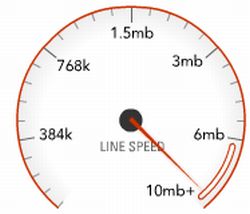
Should I Switch to High-Speed Internet?
I agree with you... all the terminology surrounding internet access is unnecessarily confusing. There are two basic types of internet access: dialup and high-speed. Dialup (connecting a regular phone line to your computer) has been around for many years. Unless you have specifically requested a high-speed connection from a cable, telephone or satellite provider, you have dialup.
Dialup connections are fine for casual email usage and visiting the occasional website. But since the speed of a dialup connection tops out at about 6000 characters per second, it's frustrating when someone emails you a large photo or you try to view a website rich with graphics or video content. It's common for a photo to be 1 megabyte (one million characters) or larger, so that means you'll be waiting about three minutes for it to download. Videos can be hundreds of megabytes, which makes them all but impossible to view with dialup.
 Should you switch from dialup to high-speed internet? The answer is YES, if you feel you are spending way too much time waiting for photos, websites or other Web content to load. You may also be concerned about tying up your phone line for hours, or getting flack from friends who always get a busy signal.
A high-speed connection can be 20 to 100 times faster than dialup, depending on the option you choose. And a high-speed connection won't tie up your phone line -- you can surf the Web while you make and receive phone calls. High-speed costs more though... expect to pay between $25 and $45 per month. If you're paying AOL $20 a month for dialup, the switch to high-speed may be a no-brainer.
And just to stir the pot a little more, there's an intermediate option offered by some service providers like Earthlink and NetZero. This so-called "high-speed dialup" or "accelerated dialup" CAN make your dialup connection go 4-5 times faster, but only for certain types of data. It will help with some web pages, but it will NOT speed up web-based music or video, nor will it help with emailed photos or secure sites. I'd go for this ONLY if the cost of high-speed access is outside your budget, or high-speed is not available in your area.
What is Broadband?
Getting back to your original question, broadband is just another term for a high-speed internet connection. It's a little geeky in its origins, and refers to the size of the wire connecting you to the internet. You may hear people talk about their connection as a "pipe" or say things like "online video requires a fat pipe." Just remember this: Broad=Fat=Fast and Band=Pipe=Connection. Broadband is ANYTHING faster than dialup.
Remember before when I said a high-speed connection can be 20 to 100 times faster than dialup? The difference in speed comes from the fact that there are three basic types of high-speed access: DSL, Cable and Satellite.
- DSL service is offered in many residential areas by the local phone company, usually costs around $25/month, and typically has a maximum speed of 768 kilobits/second, or roughly 100,000 characters per second. Your phone company may advertise that DSL is "up to 50 times faster than dialup" but that's only true if you have a REALLY bad dialup connection. (Some DSL packages only offer 384 kilobits/second, so buyer beware.) In practice, DSL will be 10-20 times faster than dialup, and because it replaces your old analog phone line, you can make or receive calls while you're online. Contact your phone company (or visit their website) to see if DSL is offered in your area.
- Cable Internet service is offered by most Cable TV providers, costs about $45/month and typically has a maximum speed of 6500 kilobits/second, which is almost one Megabyte (a million characters) per second. Some cable providers limit you to 1500 or 3000 kilobits/second, so be sure to ask. A cable internet connection is ideal if you're into online music, video, or software downloads. Check with your cable provider to what packages they offer (speed vs. price) and choose the one that fits your budget.

- Satellite Internet service should be considered only if DSL and cable are not available in your area. Top download speeds on a satellite connection are slightly less than DSL, and upload speeds are about 10X slower. (Upload speed is important if you email photos, or upload files to maintain a website.) Satellite is typically priced higher than DSL or Cable, usually requires a long-term contract, and is more likely to be flaky when the weather is bad.
There is fierce competition between the phone, cable and satellite companies, and there's even some crossover in their offerings. For example, some phone companies are offering television service, and cable companies are offering telephone service. So look for package deals that combine your phone, TV and Internet access on one bill to save money.
Got the Need for Speed?
I know I said there are only three types of high-speed access, but I think it's worthwhile to mention that Fiber Optic connections are being rolled out in some areas, offering speeds of 10-30 Megabits per second at prices that are comparable to (or less than) cable internet service. I recently got Verizon's FIOS service for $25/month, and it's blazing fast! And unlike cable access (where your whole neighborhood shares available bandwidth) with fiber you have a direct line to the Net.
If want to go REALLY fast, or you have a business where the Internet pipe must be shared by many employees, you can opt for a T-1, DS-3, or OC-3 connection. These options are MUCH more expensive than residential DSL or Cable service, but I mention them for completeness.
What type of connection do you have? Are you satisfied with the speed? Post your comments below...


This article was posted by Bob Rankin on 16 Nov 2006
| For Fun: Buy Bob a Snickers. |
 |
Prev Article: Is Firefox For Everyone? |

The Top Twenty |
Next Article: Revealing Your Email Address |
 |
Post your Comments, Questions or Suggestions
|
Free Tech Support -- Ask Bob Rankin Subscribe to AskBobRankin Updates: Free Newsletter Copyright © 2005 - Bob Rankin - All Rights Reserved About Us Privacy Policy RSS/XML |
Article information: AskBobRankin -- What is Broadband? (Posted: 16 Nov 2006)
Source: https://askbobrankin.com/what_is_broadband.html
Copyright © 2005 - Bob Rankin - All Rights Reserved
Most recent comments on "What is Broadband?"
Posted by:

WAQAR AHMED
22 Nov 2006
Hi i am from Karachi Pakistan. In my country there are mostly Dial-up connections in residential places that consist the speed of 56kb/sec and some of the cable service provding is more better then dial-up connections..
Posted by:

Gary Lefmann
28 Nov 2006
I have cable access through Charter, and when it works, it works well. Occasional weather-related outages, or having to occasionally reset the cable modem are frustrating, but most of the time, the 3 kilobit/sec download speed is worth the minor annoyances. I've got it bundled with my cable TV, but I REFUSE to give them my phone business, too. That would be like letting Microsoft run the Internet.
Posted by:

Gary Wigle
28 Nov 2006
I spent years using dial-up. I live is a small village in Mid-Michgan. The phone lines here are really bad. Mr. Bell install the lines about 100 years ago....really.
Now a company has come along and offers wireless. They are using a cell phone tower and I get 1.2megs. That is very close to a T-1 speed. $40 a month. I'm happy! The internet is real fun at this speed.
Posted by:

Martha R. Thomas
28 Nov 2006
My friend has recently taken to the roads with his pick-up and a new trailer, traveling the byroad of America. His intention is to hook-up to the internet with a satellite mounted on top of his trailer. He's not a happy camper. There is a specific satellite which he must hook up with. Aiming for it and finding it are not easy and this guy is a real nerd! He's forced to stop at libraries in little out of the way towns to do his communication. I feel sorry for him.
Posted by:

M. Grant
29 Nov 2006
I'm upset enough at our ten-year-old, 26.4 KBPS connection that every time I go online, I actually entertain dark conspiracy-theory thoughts about the class war that seems to be waged against us rural dwellers. It's impossible to be online these days with such a connection-- and, of course, more and more content is directed online! ("Don't call anymore-- go to our website for faster service!") Satellite service is astronomically high-- I don't understand what marketing survey told these providers that the small-town and rural population is so wealthy that we can realistically afford the equipment and contracts. I am livid about this subject. And no, moving is not an option. Thanks for letting me rant, Bob!
Posted by:

Miles Baska
29 Nov 2006
Bob, I don't know where you got your information, but it's not even close to the way things are down here in central Texas! DSL will run on up to 6M -- which is what I'm pulling. I rarely find a web site that can feed me data at the rate I'm able to pull it down, but I average over 4M. It costs me about $30/mo. Basic DSL gets you 1.5M for $9/mo. Though that's the speed of a T-1, don't let that fool you. The T-1 is still 'faster'. And a LOT more money.
Then there are several wireless options -- some from the cell phone providers (Sprint, Verizon...), some from local government (Muni Nets), several ways to use wide-area wi-fi, Motorola's Canopy systems... Not to mention satellites. Some of the new wireless players are offering speeds close to 40M for $60/mo. with a one-time setup fee of $200.
EDITOR'S NOTE: As I said, speeds for cable access will vary. I got 6 Mb/s with OptimumOnline, but only half of that with RoadRunner. You're lucky to have such good prices for broadband in your area. But they are far below the norm in most areas.
Posted by:

Leilani
29 Nov 2006
I have wireless access and its blazingly fast. I've tried broadband in my neighborhood which is mostly older homes and it was a nightmare. After every storm I would have an outage and when you rely on the Internet for your job (I work at home) and it goes out because of a storm, then you need something else. I would like to hear your thoughts on WiFi access.
EDITOR'S NOTE: If you live in an area that offers Wifi, you're very lucky. It's rare to have it outside of urban areas. As for security, see http://www.askbobrankin.com/is_public_wifi_access_safe.html and http://www.askbobrankin.com/wireless_security.html
Posted by:

John
29 Nov 2006
I started out with dialup, 9 years ago, and went to cable when it was first offered here. AT&T became Comcast and is now Time Warner's RoadRunner. The cost is a freakin' RIP-OFF, nearly $60 per month, and their customer service sucks ... incredible phone wait times. Some neighbors and friends have DSL, and it's much slower than cable. I'm in a Verizon area, but FIOS (fiber optic) isn't offered here, yet. I'm jumping on that as soon as it's available. There are several sites on the internet where you can test your download and upload connection speeds.
If you upgrade to Cable or DSL, tell the service providers that you don't want their icons and gimmics in your browser. Just get the service and keep your browser intact. I would never use their install discs or download from their sites.
EDITOR'S NOTE: For speed tests, go to http://www.speakeasy.net/speedtest
Posted by:

Ivan (Please don't get Verizon on my case) Furd
29 Nov 2006
According to the Washington Post (WP) article "Who's a Bandwidth Bandit?" [http://tinyurl.com/hthhf] at one time Verizon (Vz) offered an "unlimited high-speed wireless Internet access" for $60 per month. However some of the people who purchased this service discovered it wasn't really unlimited and the discovery happened when Vz abruptly cut them off and charged them a $175 early termination fee.
Seems the "unlimited" service is limited to 5gb/month or 166mb/day. If you go above that, Vz Security can infer that you're using the service for a prohibited activity, like downloading music and movies or watching p**nography. And they will use that to terminate your contract and nail you with an early termination fee. According to Vz's Acceptable Use Policy "3. You may NOT use the Service as follows: ... (n) to generate excessive amounts (as determined by Verizon in its sole discretion) of Internet traffic..." [http://tinyurl.com/bqsvs]. At this time you can view this page by going to verizon.com, clicking on the FIOS or the "Last Chance! Get DSL..." hyper links and then clicking on then surfing to a page with the "Verizon Online Policies," hyper link. According to the WP you only find out about the specific limits if you happen to talk to a Vz employee who's sympathetic or backed into a corner.
If there is any local, state or federal agency looking at this I'd love to know about it. In the meantime, "Pirates ye be warned" [http://tinyurl.com/y5u9vs]; but which one's the pot and which one's the kettle?
Posted by:

Ivan Furd
29 Nov 2006
P.S. And people wonder when I'm going to "wind my watch," and switch from dial-up to broadband.
Posted by:

Don Trottier
29 Nov 2006
After using dial up since it was first available (yes, around the time of T-Rex) I am now considering going with Sprint's "air-card" for $60 per month. It would be financed by cancelling my land line (which can't provide DSL in my area) and the $15 per month I spend on an ISP. Sprint tells me there is no activation fee and they will provide the "air card" to plug into my desktop's USB port for no charge. My wife and I would then rely on our cell phones. Far faster internet access for a difference of about $5 a month in total costs. I'd be happy for any observations.
EDITOR'S NOTE: If the speed is acceptable, it sounds like a good plan.
Posted by:

Glenn P.,
29 Nov 2006
Hey, you think Dial-Up TODAY is bad? I started going online in the mid-1980's with my trusty Commodore-128, at 300 baud (!) and then later moved on up to 1200 baud. When I'm not surfing via DSL on our Windows XP Pro box, I still use my C128 -- only now I use an Aprotek modem, which gives me a whopping 2400 baud. (And no, I am NOT joking!) :)
Posted by:

Anna Roscello
01 Dec 2006
I've been so thrilled with my Optimum service, it's not even funny. I moved to Connecticut from the Tampa area, where Road Runner prevailed, and I thought it was great and worth the $49/mo for 2-3mbps I was getting. I came to CT and signed with Optimum, and took their one-year promo plan that includes Unlimited national calling on their phone plan, with voice mail that can be accessed online; Upgraded cable through Cablevision, 100+ channels; and BLAZING internet speeds, in the vicinity of 17mbps(!) for $29.95 per service!
For under $100, I have cable, phone, and lightning-fast internet. I RARELY lose cable service (like I often did with Road Runner), and I call all over the country and never have to worry about talking too long! The above rates are good for one year (compared to RR's intro special, which lasted 6 months), and even after that expires, the rates are still superior to my old RR rates. If I wanted to upgrade to 30mbps (yikes!), their Optimum Boost is reasonably priced at $9.95 additional.
Posted by:

Domenic
04 Dec 2006
Seems like broadband access is still costly in the States.
In Australia, broadband starts from about $20 ($15 US) for a DSL plan with Optus...
Posted by:

Peter G.
02 Feb 2007
I travel a lot and am currently in Panama. I need a fast connection with minimum installation problems/cost. I found a provider for about $40 month. They provide a wireless modum which you just plug into the power with 10/100 connection to computer. The service is fast with very few interuptions. No telephone or cable installations and same day on line.
Posted by:

GMZ
03 May 2007
wow I'm surprised about the prices in the above article. I have something between 60-80 mbps ( like 10 MB/s download ) in my country with only 15$/month - and I dont' get any promotional offer. Every user of the ISP pays the same. nice huh ?
Posted by:

fritz
12 Jun 2007
yea but in australia they give you super fast service then nail you with 1-5gb caps... i lived there and every provider had a cap.. oh yes we offer 30Mbps for 15 a month... but wait we have a 2GB cap... dumb.. its all because if you go to overseas websites they have to pay more and stuff... proudly surfing at 12MBps in rural new york with fairpoint dsl.. all for $50 a month.. not bad..
Posted by:

Roger R
24 Jan 2008
How do cable companies get their signal? The local cable company here uses rather large satellite dishes. I have fiber optics here, so went with BellSouth DSL, about 350-400kb/s, I love it! Costs with other phone services approx $15/month
Posted by:

Patti Lance
21 Mar 2008
Great info on DSL, Cable and satellite! My issue is this. We have a place in Georgia and one in North Carolina. We travel between the two places during the year. Currently we have dial-up. It is my understanding per my current provider if I wish to upgrade from dial-up to DSL..I would be forced to have a DSL account with them in both places and pay two monthly charges. Seems we can't "take" DSL with us as we do dial-up. Is this entirely true or fiction? Thanks, Patti in GA/NC
EDITOR'S NOTE: Yes, unfortunately that sounds right. The DSL service is something that must be installed at a specific location.