


Is Free Wifi Illegal?
Sometimes when I'm away from home, I'll park my car, fire up the laptop and get online with a free unsecured wireless signal. Is this legal? |
Accessing Unsecured Wireless Networks
If you're parked outside a coffee shop, I'd advise you to go in and buy a latte before going online. It might be a LOT cheaper than the fine and legal fees you could get hit with. You are right to be concerned about the legality of connecting to an unsecured network without the permission of the owner. Yes, it's true that many homes and businesses don't bother to protect their wireless signals with a password.
But is it legal to mooch someone's wifi connection? It seems to depend on where you live... In the past few years, there have been arrests in Florida, Illinois, Washington, Michigan, Singapore and the U.K. involving people who have "borrowed" a wireless internet signal.
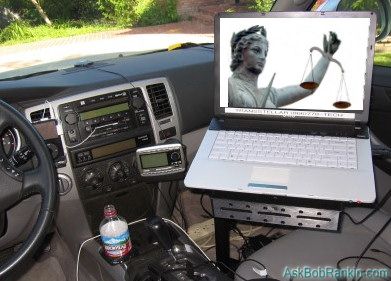
- Richard Dinon, of St. Petersburg, Florida, noticed a man parked outside his home, using a laptop. When Dinon approached the car, the man closed the laptop. A few hours later, the man was still there, tapping away on the laptop. The homeowner called the police, who arrested Benjamin Smith under a Florida law that prohibits accessing a computer or network without authorization. Police also confiscated his laptop, in order to determine if Smith was merely checking his email, surfing p**n sites, or trying to hack into Dinon's computer. It turned out that authorities did find child p**n on Smith's computer, and sentenced him to five years of sex-offender probation.
- Sam Peterson, a Michigan man who was in the habit of parking outside a local coffee shop, was arrested and charged with "fraudulent access to computers, computer systems, and computer networks" -- a felony charge that could have resulted in prison time or a $10,000 fine. But since Peterson was apparently unaware that he was doing anything wrong, he got off with a $400 fine and 40 hours of community service.
- In a similar case, Alexander Smith of Vancouver, Washington, had a habit of parking in front of the Brewed Awakenings coffee shop with his laptop. Smith was warned by the local police, but nonetheless returned to the scene of the wifi crime. Smith was arrested and charged with "theft of services."
I've had personal experience with this issue. When Verizon installed my FIOS service, they supplied a wireless network router. I rarely use my laptop inside the house, so I never thought about checking the settings. But not long after, I would notice people parking in front of my house for 20 or 30 minutes at a time. This went on for a few weeks, and finally it dawned on me... they could be tapping into my wireless internet signal. I checked the router, and sure enough, it was wide open. I added a password, and whaddyaknow, nobody parks in front of my house any more!
Wireless and the Law
 Some states and locales do have laws against unauthorized use of a computer or computer network. I found a page that provides links to Computer Hacking and Unauthorized Access Laws on a state by state level, but it hasn't been updated since 2006. If you know of a better resource for laws that pertain to wifi, please let me know. As an aside, it may be illegal to share a neighbor's wifi, even with permission. Most Internet service providers have terms of service that prohibit subscribers from sharing their wifi signal with non-paying customers.
Some people liken wifi mooching to trespassing -- entering a home or business without the owner's permission. Just because the door is not locked, that doesn't make it right to sneak in. But it's also quite possible for non-techie users to turn on their laptop or iPhone and connect to an unsecured wireless signal without knowing it, or without knowing they might be doing something wrong. I recommend that you DON'T connect to unknown wireless networks, and always get permission from the operator of any wifi access point before connecting.
A Victimless Crime?
Certainly it's rude and perhaps unethical to use the coffee shop's wifi signal without buying anything. And it's a little creepy to park outside someone's house in order to mooch off their wireless internet. But should it be considered criminal? If a homeowner or business has failed to -- or decided not to -- secure their wireless, should it be fair game to passers-by?
Some say this is a victimless crime, and compare using an unsecured wifi signal to listening to free radio or TV signals. But what if someone used your wifi to access kiddie p**n sites, or illegally download music? You'd have a really hard time convincing authorities that it was some guy in your driveway, and not you. What do you think? Should it be illegal to access unsecured wireless? Post a comment below...
|
|
|


This article was posted by Bob Rankin on 8 Oct 2008
| For Fun: Buy Bob a Snickers. |
 |
Prev Article: Wifi Sniffers |

The Top Twenty |
Next Article: Free Fax Software |
 |
There's more reader feedback... See all 33 comments for this article.
Post your Comments, Questions or Suggestions
|
Free Tech Support -- Ask Bob Rankin Subscribe to AskBobRankin Updates: Free Newsletter Copyright © 2005 - Bob Rankin - All Rights Reserved About Us Privacy Policy RSS/XML |
Article information: AskBobRankin -- Is Free Wifi Illegal? (Posted: 8 Oct 2008)
Source: https://askbobrankin.com/is_free_wifi_illegal.html
Copyright © 2005 - Bob Rankin - All Rights Reserved
Most recent comments on "Is Free Wifi Illegal?"
(See all 33 comments for this article.)Posted by:

Robert Kelly
21 Oct 2008
should be illegal. Just because someone forgot to lock their door (or doesn't know how) does not make it OK to come in and take a shower using their hot water. Any WiFi access point hardware (and the line to which it is connected) has some capacity limit. That is, some maximum number of KB/sec or MB/sec. If you use the service, you are slowing down their software downloads or online gaming. In my particular case, my ISP charges according to the number of simultaneous users - one user, 1st tier; 2-3 users, 2nd tier; 4-?? users, 3rd tier. We have a desktop and two laptops so I got a "No No" letter and a new rate. So moochers could and would drive up my monthly rate.
Posted by:

trouble
21 Oct 2008
Well, for all of those that are sating that it should not be an offense because it is being broadcast, "like someone's sprinkler coming over your fence".
That's all good if you want to simply capture wireless broadcast packets and archive them on your computer, but the actual using of the internet requires you to send information back across that signal. Even clicking on the internet sends packets and informtion across the open network connection, especially if cookies are being read and scripts are being executed.
So it is not a "receive" only situation. You are sending unsolicited information across their network. This can also become a form of interference if your bandwidth usage is too high. The laws are not being poorly applied to modern technology. They are equivalent to using the same frequency and tower to broadcast your own radio station that your favorite FM station uses.
Posted by:

Jon
21 Oct 2008
I've used "free" (unsecured) wifi all over the country & it never even dawned on me that it might be illegal. It's like someone saying, "You're breathing My air." My personal system is protected, but it wasn't always & I wouldn't have taken issue with anyone who wanted to borrow it.
Posted by:

zibeli
21 Oct 2008
Some related and, imho, interesting, considerations:
1. Is or should should it be illegal for me to passively listen in on the traffic of someone who has not secured (i.e. encrypted) their wireless connection? With a wireless packet sniffer, this is easy to do and would entail only listening in on their communications without generating any additional traffic on their connection or overhead on their router, negating many of the previous arguments against actively using their open wireless. Would their choice not to encrypt their own traffic mean they have no expectation of privacy and make passively listening in on it analogous to listening to somebody else's conversation on a bus, for example?
2. If somebody else chooses to use my open wireless connection without my permission, is or should it be illegal for me to listen in on and/or alter their communications for my own purposes? Again, easy to do and if that person is stealing services from me do they have any right to expect privacy, accuracy, or safety?
Posted by:

Zibeli
21 Oct 2008
> The downloader is tracked from the computer IP.
> Have you ever known an ISP to be prosecuted for
> facilitating the download of p**n? Don't think so.
> Unlikely a wifi 'owner' would be prosecuted for
> third-party downloads.
The ISPs generally track which of their customers were using a given IP at a particular time (and in some jurisdictions I believe are required to do so) so can tell the investigators which customer's account was responsible. Most wireless routers and their users don't keep such records so would have no way of knowing or showing what internal IP on their wireless LAN downloaded any given file, much less who was using that internal IP at the time. Since the external IP seen by the website at the other end of the Internet (and by law enforcement monitoring the Internet traffic) would generally be the same for all those using the wireless router at any given time, the wireless owner would have no way of proving it wasn't them or of showing who it was.
I'm no lawyer and have no idea what the legal ramifications of this may be, but since you said that the "downloader is tracked from the computer IP" I wanted to clarify that the "computer IP" on the internal wireless LAN is generally NOT the same as the wireless router's IP on the external internet, and that the latter is the only one anyone on the Internet will see regardless of which of the computers using the same wireless LAN originated the request.
Posted by:

emmayche
21 Oct 2008
The mere fact that your base station (a) broadcasts its SSID (name) and (b) has no password is far more than the "open door" analogy - it's like posting someone outside your door with a megaphone advertising that your door is open, and that all are welcome!
For my customers, I _always_ make them choose a wireless password, and set the SSID to something like "PRIVATE NETWORK" or "NOT FOR PUBLIC USE" - in other words, a definite equivalent of both a closed door and a "No Trespassing" sign.
An open network which broadcasts its name (how many 'linksys' networks have YOU seen?) can be reasonably presumed to be an open invitation. I'm not an attorney, but something that is left open when the documentation to secure it is so simple creates a strong presumption in favor of the "intruder."
EDITOR'S NOTE: You're pre-supposing a LOT of computer savvy on the part of the computer-using general public. I still meet people who don't understand the concept of copy & paste...
Posted by:

peakbagger
22 Oct 2008
I had an FCC (federal comunication commision) brodcasting licence at one time and one of the laws was that it is legal to receive any signal that is not scrambled ar secured so I think that the law has to be changed if they don't want people to intercept routers.
EDITOR'S NOTE: Yes, but using free wifi is not just receiving. You're also transmitting over the same link.
Posted by:

mosdefinite
24 Oct 2008
I am a bit confused with all of the "it would be like" analogies. This is a whole new concept and not really "like" anything else. The question should be limited to "is this specific action wrong?" not "this is wrong, because it is like this other thing and that is wrong". It would be like saying "My house is green. mari is green. mari is illegal, so my house should be illegal. come on. We could say it is LIKE just about anything. and it is especially NOT like burglarizing someone's house. I shouldn't even have to explain how ridiculous that comparison is.
EDITOR'S NOTE: First you argue that no analogy should be allowed. Then you accept the analogy and suggest that it is flawed. That's like double-speak... :-)
Posted by:

Mikey
12 Nov 2008
Besides unauthorized accessing public, free Wi-fi another consequence the owner's computer might be hacked or compromised by hackers. Yup! Pay first before attemping connection. LOL I did that allooong time ago on some cafe and link to a wi-fi provider page. Maybe they should put a Provide page as well
Posted by:

leon dombroski
16 Aug 2009
perhaps wifi should be produced for 'password' only use.then no wifi site would be 'unprotected,or open',and if you are 'invited' to a parking lot to use it for free,the password could be posted for all invitees to see. sounds like a good idea to me.
Posted by:

bigeasy
29 Oct 2009
The first thing that came to mind was the FCC rules on reception of transmissions. Are the signals we are transnmitting any different than the little hand-held radios that are very common now? I don't think any state or local government trumps the Feds. Second thing was how can theft of services apply to somthing that is free?(Coffee shop.) Next, and I'm sure this will be very unpopular.How did we allow a law that makes it illegal, to have a picture of something that is illegal? Can the powers that be, tell what has passed through my router? Does a router make copies or have a memory? Laws like this(wifi)would/will help to erode our freedoms and liberties. Secure your goods, and don't worry. I'm tired of protecting the stupid,ignorant,lazy, with nusence laws. Lastly why do we really care.People who feel violated by this probably feel violated by most things.(and walk thier dog in someone elses yard) Yes,If you park in front of my house to get my wifi that would be creepy, but it would be strange regardless of the circumstances,stopping there to make a phone call,read a map what ever. I hope my neighbor doesn't play his radio to loud I might hear it! Oh yea,I can't cut or paste yet.But my systems are secure,I hope.
Posted by:

dan
31 Oct 2009
According to the FCC, the airwaves are free. In other words, it is legal to capture anything broadcast. Yes, anything. This is how radar detector cases are fought in states that attempt to outlaw such devices. It is a radio receiver, the speed device emits radio waves, and the receiver picks up the waves. Federal law allows this to happen. Why do you think we can listen to police radio? It is incumbent upon the broadcaster to encrypt broadcasts.
Posted by:

Rpb
10 Jun 2010
I think we need a law saying that anyone who chooses not to secure a WIFI spot is inviting it's use by any user within range. The interloper takes nothing of permanent value, except perhaps a bit of bandwidth when the owner is online, and that can be recovered simply by securing the network. It should, of course, continue to be illegal for the interloper to attempt access data on any other computer on that network.
EDITOR'S NOTE: In some places, there are laws that do exactly the opposite. Failure to secure your wifi is illegal!
Posted by:

Ky
09 Sep 2010
Darn and I thought I was doing my part by contributing to an open free society.. I have nothing worth taking on my computer or in my identity. I freely share most of what I own with certain boundaries to keep my self respect and to keep me safe. The only thing you can not have is my son or my dog_for those I will fight to the death, as will they. Drive by if you want, access is open. Most folks I know on the road share theirs as well. Guess I may hear from the airwave Nazis one day. This from a gal who leaves her outside water faucet unlocked so that passers by can grab a drink or can fill water for their dogs. (It is located outside of my secure gate_ and I pay for my water) To this day no one has abused it. But that will be our next reason to go to war.Water. Then maybe airwaves.
Posted by:

RJ
29 Sep 2010
Thank you for the article and info. However, if you get arrested because of connecting into someone's unsecured wifi, then the wifi owner should also get fined for violating your air space and sending the signal beyond its useful perimeter and into your computer. May be an attorney can start something going.
EDITOR'S NOTE: Violating your air space??? If my tree casts a shadow on your lawn, am I violating your sun space? If I leave candy in a dish on my desk, am I violating your temptation threshhold? Yes, let's call in the lawyers!
Posted by:

Cobey Kaufman
12 Oct 2010
Thanks for the insight. Intuitively, I believed there were legal ramifications to using wifi resources without permission. It's good to see it spelled out. There is some merit in the perspective of some that leaving a resource unprotected invites others to take advantage. That being said, it is still inherently dishonest. Looking at it another way, is that behavior we would use as examples for our children or grandchildren? Thanks also for the link to the State-by-State law references on this subject.
Posted by:

Ryan
28 Nov 2010
I used to get yelled at by my stepfather for using wifi at home to do my high school/college work. I would also use a few social sites but I didn't see the harm in using an unsecured network to get some work done or to socialize. To be honest I still don't see the problem with using an unsecured network. As for what was stated in the article, downloading illegal music? Looking at child p**nography? How many people are going to be blamed for that through wireless access? I doubt it holds merit in court or that it is as common as it was implied in the article above. I really see no problem in using unsecured networks because most people use passwords if they bother to set it up. And how is using PUBLIC unsecured hot spots illegal? I mean sure its polite to go in and buy a coffee or buy a burger at McDonalds but seriously? Arresting someone for using an advertised hot spot? Well then I should be in jail for getting through my college work by using unsecured networks in public places (EI Library, McDonalds, ect).
Posted by:

Walter
16 Feb 2011
I think that if it's unsecured it's like an open invitation. You're providing a service so people will go there. Are people gonna abuse that, sure, but they're going to have a good image about you for it.
If you don't want people hanging out lock the door with some sort of security. It says, keep out pretty loudly.
Posted by:

George Worley
10 Feb 2012
I think that transmitting any broadcast signal that is in the open should be legal. I also think that if one doesn't want someone else using their Wi-Fi connection then it should be security with WEP or WAP. I also think that there should be some conformity of the laws from state to state.
Posted by:

MES
09 Nov 2020
We are facing an interesting challenge. We are being sued for accessing an adjacent business's WiFi over a 3-year period. The WiFi is not password protected. There is a sign on the front of the business advertising free Wifi. There are not qualifiers, such as "WiFi for customers and guests." We have frequently made purchases from the business, which is a concession on public land. At one point, a family member inquired about using the WiFi and the employee said, "Sure, it's for everyone." People visiting the area drive to the business parking lot or along the road to use the WiFi during and after store hours. As we have asked around, no one has heard of anyone being told not to use the WiFi. I had never heard of the term "piggybacking" until the threat of a lawsuit surfaced. I wanted to work from the cabin and needed a higher quality signal, so we subscribed to an internet service more than a year ago. Thoughts or advice?
EDITOR'S NOTE: I'm not a lawyer, but my advice would be to make your case in court just as you've done here.