

File Sharing Student Fined $675K
Joel Tenenbaum is a grad student at Boston University who was sued by the Recording Industry Association of America for activities on file sharing sites. Tenenbaum was found guilty and has been ordered to pay damages to RIAA in the amount of $675,000. That's $22,500 for each of the 30 songs that he illegally downloaded and distributed via peer to peer networks. Is Tenenbaum a marytr for Fair Use, or a common criminal? Here's the full story... |
The Joel Tenenbaum File Sharing Case
The verdict in Tenenbaum's case is based on the overwhelming evidence that indicated that Tenenbaum "willfully" broke copyright laws. In fact, Tenenbaum freely admits that he downloaded hundreds of songs using Kazaa, Limewire and other P2P services. However, while there was plenty of evidence that proved Tenenbaum infringed on the rights of the copyright holders of the music that he downloaded, his legal counsel still argues that the court ignored "fair use" claims and that his client was victimized by excessive damages.
Case Precedents
Over the last seven years, music companies have filed copyright infringement suits against 30,000 individuals because of illegal Internet downloads of their music. Of those accused, nearly every one has settled out of court. The average settlement ranged between $3,000 and $12,000, however, only two of those cases have gone to trial, resulting in price tags of $675,000 and $1.2 million for the illegal downloads.
Tenenbaum Case Information
The Tenenbaum case started back in 2003 when the young man was sent a threatening letter that told him to cease and desist illegally downloading music from RIAA. This letter offered Tenenbaum the opportunity to settle the infringement case for the amount of $3,500, which he turned down. However, he did talk with the RIAA's payment center and offered to settle the situation for $500. He sent the company a money order for this amount, but this offer was rejected.
Tenenbaum didn't hear anything from the RIAA for nearly four years, in which time he continued to download and distribute RIAA copyrighted materials online via various P2P networks. In 2007 he was sent a summons to appear in court to face infringement charges. Unlike most of the 30,000 other people accused of infringement, Tenenbaum decided to fight the charges and submitted his answer to the court. In his answer he filed a counterclaim that stated that the excessive damages that he was being charged with were unconstitutional and that the company was abusing their federal power to prosecute him. When Tenenbaum appeared in court he offered to settle the case for $5,000, but this offer was denied by RIAA. They countered with a settlement offer of $10,500. This time Tenenbaum declined the offer. At this point the case went to trial.
At the end of July 2009, a jury ruled in favor of RIAA. Their ruling was based on an overwhelming amount of evidence that showed that Tenenbaum not only downloaded but also distributed hundreds of illegal downloads via P2P networks. They also took into consideration the numerous warnings that Tenenbaum received that told him he was breaking the law and that he would be prosecuted for his actions. Oh, and there was also Tenenbaum's glib confession. They concluded that this showed "willful" intention to infringe on RIAA's copyrights. Their verdict ordered Tenenbaum to pay $22,500 for each of the 30 confirmed illegally downloaded songs, which amounted to an award to RIAA of $675,000.
It Could Have Been Better
Going into the final trial, Tenenbaum's counsel was confident that he could get his client off with a much better verdict. This confidence was based on a case that was built on the "Fair Use" argument. This argument is based on the legal distinction between infringement and fair use. The Fair Use law upheld by the U.S. Copyright Office states that there are certain situations that someone could use copyrighted materials without gaining permission.
To be classified as a fair use incident as opposed to an infringement incident several factors are considered including: the purpose of the unauthorized use of the copyrighted material, the percentage of the copyrighted material that was used, what type of material was used and the impact on the market value of the material caused by the unauthorized use. Unfortunately for Tenenbaum the judge presiding over his trial ruled that "fair use" was not an allowable argument in this case.
It Could Have Been Worse
While the verdict for an award of $675,000 seems excessive the final payout could have been much worse. According to the Digital Theft Deterrence Act willful infringement of copyrighted materials could have a per incident price tag of $150,000. This means that Tenenbaum could have been charged well over $1 million for his indiscretions.
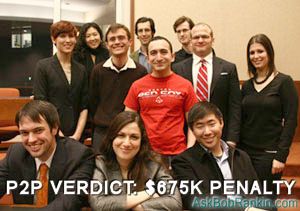
But it seems that Tenenbaum has little to lose. Tenenbaum and a legal team that's defending him for free (see photo above) are planning to fight the court's decision. And Tenenbaum says if the verdict stands, he will simply file for bankruptcy to avoid paying the fine. See more from his angle at Joel Fights Back.
Was the Case Fair?
There is a big debate going on right now as to whether this type of case is fair or unfair. There are solid arguments on both sides. On the side of the artists who create the music, they obviously deserve to be paid for their work, and the laws regarding copyright infringement are clear.
However, the other side claims that music is too expensive, that file sharing doesn't really hurt anyone, and the damages that are being asked for seem excessive. So who is right in these cases?
What's your position? Post your comments below...
|
|
|


This article was posted by Bob Rankin on 3 Aug 2009
| For Fun: Buy Bob a Snickers. |
 |
Prev Article: Do You Have a Gravatar? |

The Top Twenty |
Next Article: Google Toolbar is Spyware? |
 |
There's more reader feedback... See all 33 comments for this article.
Post your Comments, Questions or Suggestions
|
Free Tech Support -- Ask Bob Rankin Subscribe to AskBobRankin Updates: Free Newsletter Copyright © 2005 - Bob Rankin - All Rights Reserved About Us Privacy Policy RSS/XML |
Article information: AskBobRankin -- File Sharing Student Fined $675K (Posted: 3 Aug 2009)
Source: https://askbobrankin.com/file_sharing_student_fined_675k.html
Copyright © 2005 - Bob Rankin - All Rights Reserved
Most recent comments on "File Sharing Student Fined $675K"
(See all 33 comments for this article.)Posted by:

Pam
05 Aug 2009
What does the RIAA do about folks who buy used CD's and albums? What about people who check them out from their local library?
Posted by:

Ken
05 Aug 2009
To my knowledge the RIAA has yet to pay a penny to any "injured" artist. They are just reinforcing the perception of the greedy music labels.
P2P exchange of music is providing free advertising for many of these bands. I have over 50,000 songs that I have downloaded through P2P. They are not losing any money from me because I certainly wouldn't pay at any price. If I had to pay I wouldn't download. Period. The increased exposure that P2P gives these groups helps them sell more concert tickets, T-shirts, hats, posters, bongs, or whatever.
The Greatfull Dead would set aside an area for people to record their concerts. They didn't mind as long as you weren't selling those tapes. I really don't think that people taping and sharing their music hurt them one bit!
Posted by:

Ed
05 Aug 2009
I think that the RIAA and therefore the artists that they claim to represent (to a lesser degree) are jerks. Further the extensions of the copyright act in the recent past are completely unreasonable and do nothing to promote reasonable compensation for creating goods that should fall into the public domain within a fair amount of time.
However, none of that makes it fair or legal to steal something. When somebody wants to charge you too much for something, the just response is to not purchase it rather than to steal it. I say we boycott RIAA artists and only acquire music from artists who deal fairly with us, their fans. These types of artists tend to be smaller and some even self published so you know that even if you pay less for their music, more is going to the actual artist. Some even give a portion of their music away for free. Of course even some bigger acts like Radiohead and NIN are getting into the business of charging less or letting people decide what to pay.
If enough people stop buying music from RIAA artists (a trend already happening) and we have the moral high ground because we are not stealing, we should be able to collectively come to some agreement with the artists which is fair to everyone. Ideally, of course, this would involve the RIAA going away for good.
Posted by:

Julia
05 Aug 2009
I think sharing should be free and agree with the comment that it benefits artists by advertising their music.
The only people that should be punished are those profitting by selling home burned cd's made from shared music.
I have no problem with artists and authors earning royalties for each commercial cd or book or video sold. Unlike actors they are often NOT paid for the job up front and need to earn their living from legitimate sales.
Well done Joel for fighting back, and he obviously has the situation under control so he doesn't need any pity!
Posted by:

Keith
05 Aug 2009
Well, for one thing, copyrights are the law. For another; If I write a book, I want to sell copies of that book to make my living. If you buy one copy then run that book through a Xerox machine and start giving it away, I make nothing other than the 1 copy you bought.
If I patent a new battery design, anyone who uses that design to make a battery for your cell phone pays me royalties. (didn't know that?)
And is 89 cents really too much to pay for a tune? Come on...
When I was a kid you paid a buck for a 45 rpm single. That was 40 years ago. So now you don't get the "record" you just get the music. You also don't get the scratches and skips.
Copyrights are there so that creative people can make a living. The royalties go mainly to the artists, not the record companies.
And why is it that many people find 89 cents too much to pay for a download, but would gladly spend $75 or more for a concert ticket?
Posted by:

Paulette
05 Aug 2009
Tenenbaum is a thief, pure and simple. Downloading for your own use is one thing, but sending illegally downloaded music to scads of other people removes that many potential legitimate buyers. His whole attitude stinks, too. He's a cocky brat who thinks he's above the law. He knew what he was doing was against the law and continued to do it. I hope the verdict and award stand. Filing for bankruptcy to avoid paying up will haunt him for years to come. And who's going to want to hire this jerk?
Posted by:

Ralph
05 Aug 2009
All these comments make valid points and I totally agree that this fine is way out of proportion. I guess it's just scare tactics to stop the rest of the world from downloading in this way.
Posted by:

Stephan
05 Aug 2009
Of course it's not fair... it's corporate power versus democracy (in a land where corporations can pay to override democracy). The RIIA and their corporate partners lobby to change or create laws, which they then use to punish anyone who does not follow the path they have charted.
The original purpose of copyright laws was to encourage creativity and innovation, by giving the creator of a work a limited period (7 years) to profit from their creation, but then to allow that creation to enter into the commons.
Copyright laws have been ridiculously over-extended through corporate lobbying over the last century. Copyright currently last the life of the creator plus ? years -- several decades is just completely contrary to promoting innovation.
Artists only get $1.25 from the record companies for every record they sell -- copyright laws don't help individual musicians out very much. They do help the record companies, who may have 1,000+ artists signed to their label and and taking a good cut from every record sold.
Posted by:

mike
05 Aug 2009
It is the civic duty of every patriotic citizen to ignore stupid/unfair/unreasonable laws. I am glad the founders of this country felt the same. Is Tenenbaum a thief? That is a question to be answered when the PEOPLE make the laws and not corporations, lobbyists and elitists. In the mean time, Tenenbaum is no Bolingbroke.
Posted by:

Mike Keller
05 Aug 2009
First, Fair Use was a stupid argument. There are specific requirements for Fair Use, and unless he was in some other way actually using the material for other than personal listening, Fair Use doesn't enter into it at all.
Second, the artists don't get this money. You are infringing the music companies' publishing rights, not the artists. Royalties are paid to songwriters, not the musicians and bands, and the way royalties are distributed is generally unfair to the majority of songwriters. If you want to read an excellent article about file sharing and music companies and money by Janis Ian, see http://www.janisian.com/article-internet_debacle.html
Blunt fact: most artists make most of their money playing live shows, not from record sales.
Posted by:

Michael
05 Aug 2009
Joel Tenenbaum stole music, he broke the law, case closed. If you're going to willfully steal something, you're going to face the consequences sooner or later. It may not be a fine, it may be you reading a comment on this or some other website from someone who believes you're a thieving, selfish brat and that there are many others who feel the same way.
God damn, my generation is full twats like this, it's pathetic.
Posted by:

robboso
06 Aug 2009
Well downloading music is done every minute of everyday, so is speeding if you get caught you get fined 100$ , $200
It does not turn into a federal case, this has been blown way out of proportion
the downloads are good but not near as good as originals they are recordings more or less wma,mp3
or what ever format you choose everyone knows what kind of people run music companies just ask any artist that has ever been signed
My question is why would they spend near a million dollars on a suit that they knew would never get anything near that in damages they knew
he did not have the ability to pay them
Clearly they are making money or they could not afford the throw away the money on the suit
so it is not about the money if that was the case they would have took the money and run They have bribed DJ's for years to play thier songs to get them heard what is the difference thier songs are getting heard people are still buying music
They got this though in thier head because you DL music that is a sale they should have made
Most of the time it is just a way to hear the music before purchase lets face it some music is crap they just throw this stuff out there you may have one good song on an album and the rest is crap can you take the crap back not like 90% of what you purchase you can he these jeans do not fit well they album does not fit take it back a
and tell them its crap see what happens
Just like when sony paid the HD dvd manufacture to shut down they monopolised the industry no one has said a word you cannot get HD dvd now unless its bluray
both sides are dirty in all of these incedents
it is just how deep you look
Posted by:

D. Baker
06 Aug 2009
Laws were to protect people. Yes, you can break the law, it's your free will. If you get caught you should pay the fine or do the time. Plain and simple...
Posted by:

Ken
06 Aug 2009
The RIAA are legal criminals. This group has dictated how music is going to be sold, what music gets played. This group has made millions off musicians. Some may remember during the days of the cassette that an extra 2 bucks was charged for each blank cassette sold. why, because that may mean someone may copy a song, not illegal back then. So now this group of powerful men are losing that power, and like any animal backed into a corner they are trying to get that power back, through the courts and lobbist.
If coping songs back in the day wasn't illegal, what is the difference in coping songs off the net.
My guess is they have no control over that venue, and we the people have learned we don't need them dictating what we listen to.. Long live the people.
Posted by:

Ken
08 Aug 2009
My mother taught me that taking things that one didn't own was stealing, and whether or not you steal a paper clip or a million bucks, it is still stealing.
But nobody in their right mind would punish the stealer of a pepr clip the same way they'd punish the guy who steals the million bucks.
So: 30 tunes @ 89c = $26.70 and for this we spend millions to sue for $675K!?
What's wrong with this scenario?
Posted by:

John
08 Aug 2009
30 songs @ .99 cents ea is much cheaper than 30 songs @ $ 22,500 ea. If he would have paid and not willfully broken the law, he would not have to file bankruptcy. Poor decision Mr. Tenenbaum
Posted by:

Percival
13 Aug 2009
I would not kick so much if, what was left after legal fees of the $22,500 went to the artists, not the RIAA.
The RIAA keeps sending me Cease and Desist letters for illegally sharing their music. The only interaction I've _ever_ had with P2P networking is to download torrents of the software I've helped develop (like Linux versions, and Virtual Machines) and to upload photographs I've taken myself, with my copyright on them. Does this mean that they now have the right to give me the equivalent of a speeding ticket for doing the equivalent of driving near someone who was driving too fast?
At least, speeding tickets go to fund the people protecting us. The RIAA's fines? Go to their pockets, and bottom line, not to their artists, whom theoretically they are "protecting" by all this legal activity. In all the comments I've tracked, we don't even see the composers/performers of those 30 songs being involved in this case, at all. I wonder why? Shouldn't they, as the producers of what was stolen at least be mentioned, as involved? Do they care? Will they see any benefit?
Posted by:

Chris
04 Sep 2009
Children, stealing is wrong, m'kay?
Stupid question: Has the RIAA actually prosecuted anyone who had not _distributed_ copyrighted material? It is still perfectly legal to copy music for personal use. The big deal is distributing it. When he shared those songs, how many people downloaded them? That's $1 of lost revenue for every download. The big $$ settlements are for distributing the material, not for downloading it. If you steal $26 worth of stuff from wal-mart, the penalty is up to 180 days in jail. Add to that the conspiracy-to-commit for everyone who downloaded from his sharing, and criminal charges in some states could carry a combined mandatory minimum of several years in jail. He got off easy.
Some people seem to think that because the RIAA is an association of large businesses that are profitable, it is OK to steal from them. Almost every one of you either works for (or runs) a profitable business (excepting government and non-prof employees, full time college students, and welfare bums, who are all supported by taxes paid by profitable businesses). If that business suffers losses due to theft, bottom line is affected, and the number of jobs the company can support decreases. In the long run, stealing of any kind, from any company, is threatening the livelihood of an individual that has rent to pay and mouths to feed. The CEOs won't take a pay cut - they will lay off blue collar workers to maintain profitability. For example, some guy with 3 kids and a mortgage working in the CD stamping factory for $8/ hr will be a victim of illegal file sharing, or that coder working for apple who loses his job because sales are down at the i-tunes store due to the 20k songs Tannebaum gave away, etc. Yes, some of the things RIAA has tried to do are draconian. But stealing is still stealing, and it's hurting real people like you and me, not just the rich guys.
Michael: I think the only generation more selfish and entitlement-hungry than ours, is that of our kids...
Posted by:

Jim
09 Sep 2011
Chris has the best answer here. What bugs me the most about this is when you purchase an album you have the right to use the music not give it away. That's fine and the way it should be. But when the media you have wears out you have to go out and buy the music all over again. Why? You should be able to get another copy for just the price of the media. But there is a vast difference between that and what Mr. T did. To continue downloading and giving away the music even after he was told to stop shows his disregard for others. A more fair judgement would have been making him pay for every download x 5. All of them not just 30. In any case I don't care. I have never downloaded a song illegally.
Posted by:

Kenny
11 Sep 2011
The guys a thief pure and simple. If everybody downloads copyrighted material without paying for it, what's the incentive for creative people to do anything? How would he like it if his employer didn't pay him at the end of the week, claiming his hard work was too expensive? The guy needs to do some prison for his crimes, just as a bank robber would have to.