


What is Blu-Ray?
I've seen ads for movies on Blu-Ray discs but I'm not sure what that means. What is Blu-Ray and how is it different from a regular DVD disc? Do I need a special player to view a Blu-Ray disc? |
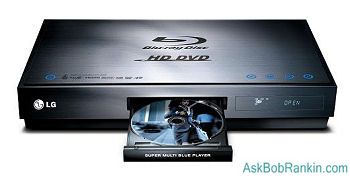
Blu-Ray Technology
Think about Blu-Ray as an advanced version of a DVD disc. Blu-Ray optical discs are used to store large amounts of data, which is suitable for high-definition video and high-density data. It's the next-generation optical disc format jointly developed by a group of computer and consumer electronics companies, called the Blu-Ray Disc Association (BDA).
Compared to a traditional DVD or HD DVD, a standard single-layer Blu-Ray disc can hold much more data -- 25 GB versus 5 GB for standard DVD or 8.5 GB on a dual-sided HD DVD. A dual layer Blu-Ray disc can hold up to 45 to 50 GB of data. This means a dual layer disc can play 8 hours of HD video. But wait… there's more! Researchers are also developing 100 GB and 200 GB Blu-Ray discs. (Sorry, no steak knives.)
A Blu-Ray disc gets its name from the blue-violet laser used to store data on the disc. This shorter wavelength of the ray (405 nm) and tighter track pitch facilitates more precise storage of data, and higher storage capacity. A conventional DVD reads and writes data using red and infrared lasers at 650 nm while a CD uses the same lasers at 780 nm. (How small is a nanometer? For reference, there are 25.4 million nanometers in an inch.) Read the Blu-Ray FAQ for more technical details about this next-generation optical disc format.
How Will The Consumer Benefit?
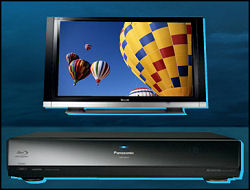 Needless to say, the larger storage capacity of the Blu-Ray disc offers consumers a lot of benefits when it comes to storing data in their personal computers. You'd need a stack of about 32,000 floppy discs to equal the capacity of a single dual-sided Blu-Ray disc. We've come a long way in just a few years!
Also, Blu-Ray technology will change the way we see movies and high definition videos. Although the Blu-Ray disc players are costlier at the moment, they are expected to become less expensive as the production increases. Sony is using Blu-Ray drives in the popular PlayStation gaming systems, which could help to boost the Blu-Ray market.
Before switching to this new technology, you should make sure that the new Blu-Ray disc player plays your traditional DVDs too. Manufacturers and video content producers have yet to embrace this technology on a large scale and not all video content is available on Blu-Ray discs. If your new Blu-Ray disc does not play normal DVDs, it may be of limited value in the short run.
Blue-Ray Versus HD DVD
Another advantage of using a Blu-Ray enabled player is that it enables a 36Mbps data transfer rate and MPEG-2 Transport Stream. If all that techno-speak makes your eyes glaze over, translated into practical terms, this means HDTV owners can record their favorite broadcast without any quality loss.
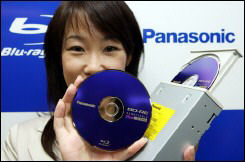 When it comes to the future of video formats, Blu-Ray is not the only whale in the fish tank. Remember the days of VHS versus Betamax? Customers didn't know which type of machine to buy while that battle raged. In a similar scenario, backers of the Blu-Ray (Sony, Panasonic, Dell, Disney) and HD DVD (Toshiba, Hitachi, Sanyo, Universal/Vivendi) technology are each hoping to triumph in the marketplace.
Due to the conflict between both the two camps, content owners are divided as well. That means you have to be careful when you buy or rent a movie. Is it in DVD, Blu-Ray or HD DVD format? And which discs will work in your player?
Blu-Ray technology is poised to change the digital world. But Blu-Ray may flop in the marketplace, just like Betamax, even though it was regarded as technically superior. My advice is to stick with plain old DVDs for a while. Let the technology and entertainment behemoths duke it out, and hopefully we'll end up with a winner (or a compromise) in the next year or so.
Got comments or questions about Blu-Ray? Post your thoughts below…


This article was posted by Bob Rankin on 30 Mar 2007
| For Fun: Buy Bob a Snickers. |
 |
Prev Article: TV as Computer Monitor |

The Top Twenty |
Next Article: Which GPS Should I Buy? |
 |
Post your Comments, Questions or Suggestions
|
Free Tech Support -- Ask Bob Rankin Subscribe to AskBobRankin Updates: Free Newsletter Copyright © 2005 - Bob Rankin - All Rights Reserved About Us Privacy Policy RSS/XML |
Article information: AskBobRankin -- What is Blu-Ray? (Posted: 30 Mar 2007)
Source: https://askbobrankin.com/what_is_bluray.html
Copyright © 2005 - Bob Rankin - All Rights Reserved
Most recent comments on "What is Blu-Ray?"
Posted by:

David
03 Apr 2007
One of the advantages of HD-DVD is that it plays DVD's too. As you mention, BluRay requires other technology to play them. Its better technology in certain ways but not backwardly compatible. HD players are also cheaper to make and are more broadly licensed. Same sort of issue as with Betamax.
There is talk of dual format discs but LG has released a dual format player - it will handle all 3 types of DVD's. Perhaps that will be the solution?
Posted by:

Warren Betanko
03 Apr 2007
It's not true that Blu-Ray has more storage than HD DVD. A single-layer HD-DVD disk holds 15 GB, while a dual-layer one holds 30 GB. If you double-side it (which is possible), that goes to 60 GB.
EDITOR'S NOTE: You're not camparing apples to apples. See the "HD DVD / Blu-ray Disc Comparison" near the end of this page: http://en.wikipedia.org/wiki/HD_DVD
Posted by:

John
12 Apr 2007
Warren, Blu-Ray has far more capacity than HD DVD.
Each layer of HD DVD is only 15GB where as each layer of Blu-Ray is 25GB. HD DVD only has a design depth of two layers 30GB. OK so you can double side it. But Blu-Ray has a design depth of ten layers, giving 250GB of storage, Now double side that! Blu-Ray was designed to be re-writable on all layers! HD is not.
Posted by:

David
20 Nov 2007
Bob, we must be of the same generation. I stumbled across your article today and i have talked a number of people out of buying a blue ray player using the VHS-Beta wars as reference, plus they don't play the dvd's you might already own. Good article. I appreciated the one on SAT tv for the pc also. Glad i found your page before i purchased. I live in Europe and am looking for a way to watch football and nascar. Nascar you can subscribe to like baseball, but not football.
Posted by:

Michael Hughes
10 Dec 2008
Its all very well fighting the numbers game over which disk can store most. But the main consumer application is recording and watching pre-recorded films. I don't need 500Gb to do that.
blue ray won, no doubt, but i'm paying for an advanced technology i don't need to watch Cameron Diaz falter thru her lines in the next mildly funny hollywood forget-it-after-a-year-film. Any DVD is good enoguh for that.
people are trying to convince us that we need blueray, we don't. what we really need is films that make us WANT to watch them in HD
Posted by:

Scott
07 Jun 2009
I am on my 3rd Dell Desk Top. The first one completely crashed and Dell did send two diffreent techs out to my home to repair. Both times, the Techs. replaced everything in my PC to no avail. This system was an XPS 710 and I paid close to $4,000.00 for it. Dell sent a replacement about 7 weeks later I received an XPS 730. It was missing my TV card as well as a few other things that my original PC had. This replacement unit showed up in a box big enough for a miniature refridgerator along with "SIX HEX HEAD BOLTS WEIGHING 1lbs. Each. These bolts obviously banged around during shipment and banged up the outside case of the unit as well as broke a front door which exposed inserts for a floppy disc, MIDI input & UBS ports. I Spoke with Dell for months about theses issues plus the fact that this PC was not working properly. Dell asked me to take photos of the damage as well as the shipping container. I did so and sent. I waited, I waited, I waited, I waited. After about 4 months I called but once again and actually spoke with a gentelman that actually spoke and understood "ENGLISH"! WOW, I was thrilled, he explained that there had been some past issues in the company and that he would handle my replacement issue from now on.
I was amazed as this Dell Tech. found the photos that I had sent months earlier and pulled up all of my corespondence about all of the past issues. He immediately dispatched a new unit to be built and sent to my home.
Although missing some components that were ordered with the original, Dell keept sending the latest and greatest including this unit that is actually liquid cooled. Wow, pretty cool (no pun intended) yet was lacking my TV Card and 3.5 Floppy Disc.
I'm willing to give the above components up for a "Blu-Ray" Player\Recorder for my system. I just need to know if anyone out there can advise on the best system to go with?
EDITOR'S NOTE: I'd just look for a reputable vendor (Sony, LG, Panasonic...) and buy the drive for around $100.
Posted by:

Rip Blu-ray
20 May 2010
oh, cool staff. Thanks for sharing.
Rip blu-ray is a sample thing.
Posted by:

East Slope Charlie
07 Dec 2012
I taught college/university for about 35 years. Once I got my real finances in order, each semester a couple of students would get a computer for further studies, one a brand-new one from Dell's 'refurbishment' department, where you would not have an 'older' computer but a new one, but perhaps with a bit more or less than they wanted. These two runner-up students paid 25% of the cost of their 'dream computer'. Top student for the semester/year got a brand-new Dell. In their name. free. The reward for being the top student of the semester out of ALL my students.
=======================================
I think I just bought my last one now that I'm retired. Blue Ray" WTF? Here's a quick way to reason: computers are released about twice a year. THE top computer now, could be number 4 in only two years or less. RIGHT NOW Blue-Ray IS the standard. So buy a Blue-Ray -- it'll sinc with nearly any other blue-ray device you might have around. It's not like you are going to be switching platforms where not only do you have the cost of ALL your software you also have the price of your computer. So since the average life of a lap-top SEEMS to be about 3 years while students have them -- don't buy top of the line, buy middle of the line. That old lap top is going away sooner than you think, not because it doesn't work, but because it's too slow, and MAY NOT integrate with newer computers.
==========================
So since I keep my computers a terribly long time, this one was built in October of 2001. I bougt FAR above what I'd need in speed, memory, HD, ports, etc. and now, yeah, it's a bit slow, but it still types faster than I do. or can.
==========================
A word is necessary for Dell home service. One of my students ended up at UOP in Stocton. I'd gotten her a brand new computer because she had done THAT well in class AND had a 2 year old son who would play with her old home-bought computer. Even if it had that 25 page analysis homework paper on it (Pick an event or historical figure from the mid 1800's and write about a 25 paper pro-and-con, you MAY use your bibliography in your page count. 2 year olds and a paper due in a month that comprises 3/4 of your grade tends to not mix well.
I got her a top of the line Dell. With the full 3 year warranty on it though I seldom do that, mostly their 1 year is good enough. When she had a paper due in about a week, that 24 hour guarantee sure helped. Dell had someone out to her apparment within HOURS of my first call, and when he couldn't figure out the comptuer, but thought for sure it was the HUGE monitor she'd gotten -- he replaced that, and drove away. About an hour later the screen acted up again. This time, ABOUT 8:30 PM (at NIGHT) the repairman shows up, and says, well I thought it was a bad screen,but it could be a bad video card, memory problems that only show up when it gets warm - so, wait -- and he brought in a computer that was ONE up from what she had, AND a new monitor, AND helped her transfer her Econ paper over to her new computer along with all other course work papers she'd done - NO CHARGE. Arrived abut 8:30 PM and left about 11 PM.
And she had a new computer -- and she said the tech said: before I brought it over I opened it up and made SURE everything was OK so you could finish your paper to night when your kid is asleep.
And thus goes Blue-Ray as a 'standard' for a computer. She can synch up files on her phone (both directions), upload blue-ray maps for her GPS unit, and what all - even downloaded some of her 'at home' work to her 'at school' work thorugh blue-ray. Cool. To replace an entire computer in ONE call is, to me, amazing.
So-- with that as background - and my own 12 year old computer chugging away at a snail's place, because when I went to buy a lap-top earlier this year, I was in the mind-set of buying off the top of the heap, knowing that in 2-3-4 years it would ALL be 'out of date'. But I seem to work on comptuers, lap tops, that are averaged at about 2.75 years, and are pretty much toast. So there was no need for me to buy 32 Gigs of RAM, super-fast SHD, HUGE screen for both the lap-top, but one, larger for home, etc. If, as I have observed, the useful life of a college students lap-top is about1-2 years, there's little reason to buy a LOT of accessories. Blue-Ray seems to be one of those 'accessories' which MIGHT go out of vogue for a bit, but not, from what I can see, in the near or apparent future, so Blue Tooth is still an AMAZING way to get data transferred between machines, and the faster the better.
So were it up to me to get a comptuer for a student, or for myself, ESPECIALLY IF IT'S A LAP-TOP -- don't buy one that will work 10 years from now like I did my Desk-Top (knock on wood, it's run 24/7 for well over 11 years) -- I'd buy one that would have a FUNCTIONAL life of 3-5 years MAX. They get tumbled about, tossed around, completely abuses -- so for that reason I'd choose soft-hardware that would last about 4-5 years (8-10 product cycles) and add a full sized keyboard, a larger monitor, and, yep, TWO floppy disks, one for the 8 inch and the other for the 4.25 inches so I can play nearly every medium out there (and, yeah, some of my old research is stored on those flimsy 8 inch disks (and I also have 4 twelve inch floppy disks for my first doctorate's data collection-- back when Lotus 1-2-3 cost just under $300 and could only be copied ONCE (unless you knew to change the registry entry from 0=1, 0=2, then change it back so the change could be copied onto the floppy 0=0, or as my office mate found out 0 CAN = 200, so you could make 200 copies from ONE lotus 1-2-3 which was WAY expensive for it's time and what it could do).
So, the major thrust of this note is: don't buy a computer that you think might last 5--6-7-8-9-10 years, forget it. Most I've seen from High School kids live about a year on average, and for reasonably semi-quasi-concerned College under grads about 3-4 years enough, they give out JUST when Junior or Senior Finals are given. So don't buy WAY into the future, your lap top is only going to last you (probably) about 5 years, and that is 20 releases of 'new' computers, and is probably time to start looking for a new one with the newer technology in it - knowing that your great great grand kids are NOT going to see the family photos here, or be able to read the notes on living life or your autobiography -- it will be blowing around on pieces of plastic not much bigger than the words they hold in the bold, and perhaps overconfident Weltanschauung which held exactly the 5 words in the title of the 20 page paper. So don't buy, and pay top dollar. for a technology that's probably not going to work in 10 or less years. Just remember that $2400 computer only costs you about $2 a month, so you surely get that much enjoyment over using it. So don't throw the baby out with the wash -- just don't guy a gold-planted tub because you think it will last forever -- I have a Mac+ in my closet at home, and yep, it works when I plug it in and let it sit for a couple of minutes to re-charge the battery inside, re-set the time, and I'm ready to go and play some rather interesting games.
The Blue-Ray disk has already out-lasted the NEW AND IMPROVED 3.25 2.44mb disk (they doubled the 1.44 disk in capacity) but I would not count on anything as radical as turning an 8" disk into a 3.24 inch disk and NOT changing the machine much, but it happened. So far, Blue-Ray and an intra-device communication tool took hold for a bit, AND it looks to me with my non-existant knowledge and asks if that is right. I have little to say, except 'yes; for now. Shrink the transmission frequency and you can speed up and put down more data that you tought was possible. But of course we now have sticks that hold as much as a case of the old-time floppy's. Just keep your buying to the next 4-5 years- then you'll want more, and by golly, 'more' is not much farther away than that project being finished this very moment in SiValley where even the inventor doesn't know if it WILL work, he only knows it SHOULD work. And you want to buy, full bore, into THAT world? Save your bucks, buy a used computer from your favorite manufacturer -- a computer returned for 'damage' or a 'failed part' is tested and re-tested until the problem is fixed for good. It does not do a company well to have it's name associated with something 'bad' like, say Dell and their batteries a few years ago -- who woulda EVER thunk they'd catch fire and burn down your entire end of the dorm or light up for you to be sure you see to be able to take notes during the lab-section of 'explosive and volatile organic chemical reactions'. I'd say Blue-Tooth is here to stay for quite awhile - just look at it's content and how 'universal' it is!!! -- that should tell you something positive about what make/model you need to get. HINT: CALL CONSUMER HOT LINES AND ASK WHICH COMBINATIONS OF LETTERS OR NUMBERS DESIGNATE A 'HOME CONFIGURATION' FOR A COMPUTER. That way if you want to spend $X and have a dual, quad core chip screaming along at 3+ GHz you can get it over a single core Pentium 4 that runs all of 32 bits with the wind witn you, peddle to the metal, sails up, down-hill with no brakes. You simply can't do what needs to be done. I am already having trouble with my ONLY 2gigs of RAM! - the max I can take on a machine this old. Good luck, and while my Master says 'blue ray may soon change' -- I'd still get a 2-3-4-5 year computer with one since you never know WHEN you'll need to change data between devices or between your computer and someone else's....beasides, how can you cheat if you DON'T have blue-ray? (Taught U for 30+ years so I have a small clue how computers are used) even if I only know a few ways to make them work! --
Posted by:

Torsten
29 Jun 2020
You say you have 12 inch floppy disks. Could you send me a picture of one? I have never seen those for real, only 8 inch. IBM has denied their existence.