


Which GPS Should I Buy?
GPS systems are useful for finding your way around, but choosing the navigation system that's right for you might be just as challenging as traveling without one. Here are some guidelines on the best GPS systems so you don't get lost in the market, or on the road… |
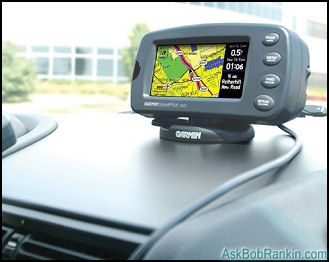 GPS (Global Positioning System) devices rely on satellites that orbit the earth. The GPS unit takes signals from these satellites which allow it to calculate your exact position on the ground. Basic devices will give you the precise time, your longitude, latitude, altitude as well as your speed in real time. Others will allow you to play MP3s and will even interface with your PDA. You can have a GPS factory-equipped vehicle, or a portable GPS which can be mounted in your car, or hand held for hiking and deep woods adventures. class="imgmain" />
GPS Navigation Systems
The quality of GPS systems vary widely. The best are those that automatically or instantly pick up a dropped signal such as when you drive through a tunnel for example while others may need a few minutes to recoup. All systems have antennas that must have clear access to the sky in order to be consistently accurate which means that urban and rural dwellers will need a more sophisticated model when dense vegetation, forests or buildings inhibit access to the satellite signals.
Choosing a vehicle that comes with GPS is great for travelers and commuters however this option is pricy and probably not ideal for all drivers. Onboard navigation systems not only give you directions but also traffic and weather updates so you can avoid problem areas. Vehicle manufacturers position the antenna on the dash with optimal satellite exposure, making these systems more reliable than portable models where you may have to reposition them over and over. Some of the newer options for vehicle installed GPS systems include MP3 players, audio books and voice command operation. This is especially useful for those that travel alone since some models will lock up when the vehicle is in motion to prevent the safety hazards of multitasking while driving.
Portable GPS Models
Portable models are great if you want to use them in multiple cars, on your bike, or on a hike. This is definitely more economical than having a system professionally installed in multiple cars. Here are some of the GPS units that I think are worth checking out...
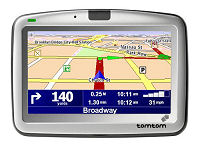 The Tomtom GO 510 GPS receiver (US$399) sports a wide 4-inch touchscreen, spoken turn-by-turn directions and comes preloaded with North American and Canadian maps on an SD memory card so you don't have to upload them from an additional source. It mounts to your windshield for portability and plays nice with Bluetooth enabled cell phones and your iPod. I've tested this model in my car and found that it was easy to setup and use. A very nice mid-level GPS, at an affordable price. The Tomtom GO 910 is a little pricier but has an internal hard drive, includes maps of Europe, can play MP3s, and display photos.
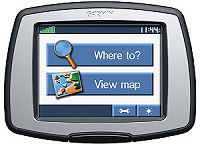 The Garmin Street Pilot C330 GPS ($US350) features a 3.5-inch touchscreen interface, automatic route calculation and turn-by-turn voice-prompted directions along the way. The database features an impressive six million points of interest including hotels, stores, restaurants, entertainment, gas stations, schools, ATMs, and tourist attractions. I liked the rotary volume knob on the side of the unit, which was easier to use than the touchscreen volume slider on the Tomtom. Selecting a destination seemed a little clunkier than with the Tomtom unit, and the display, while bright and crisp, looks a little cartoonish by comparison. But it does allow you to select either a 3-D navigational view or the traditional “bird’s eye” overhead view, which is a nice feature.
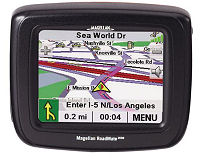 The Magellan Roadmate 2000 GPS is a good entry level product at around US$350. Like the others, this unit features simple touch-screen menus, turn-by-turn visual and voice guidance, and built-in maps. But the Roadmate 2000 only covers the continental 48 states in the USA, and has just 1.3 million pre-programmed points of interest. Other Magellan GPS receivers fill these gaps, but at a higher price point.
Of the two I personally tested (Tomtom and Garmin) it seemed that the Garmin had a much bigger points of interest database, which is a big help when selecting a destination, but it also seemed to have more trouble finding and keeping the satellite signal in rural areas. The Tomtom offered more voices, at least six, while the Garmin had only a male or female voice. I'm sure most people would be quite happy with either the Tomtom GO 510 or the Garmin C330 as a first GPS. Both are afforable, mount and unmount easily, and are simple to use.
Hand Held GPS Systems
These not only help you navigate while driving but also on foot so whether you are on a road trip, walking through a new city or hiking you'll be able to know exactly where you are and where you want to go. Hand held GPS systems are tiny -- about the size of your cell phone which makes them extremely practical. Most hand helds are also Bluetooth compatible giving you the option of wirelessly integrating them with your PDA or PC.
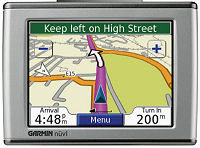
The Garmin Nuvi 360 is a touch screen pocket size GPS device, about the size of a deck of playing cards. The Nuvi also offers a travel kit of useful tools including an MP3 player, audio book player, picture viewer, world clock with time zones, currency converter and calculator. Optional Language and Travel Guides on SD memory cards can be added for additional language and content support.
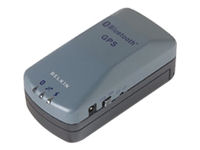 The Belkin F8T051 Bluetooth GPS Receiver connects to your laptop or PDA. Its ability to maintain satellite signal is superior, out competing many other GPS models. This model indicates your speed, direction, elavation, latitude, and longitude within 10 meters, which makes it ideal for hikers. The software included covers all of the US and Canada.
When you decide on a GPS be sure to read the fine print. Make sure it allows you to update the maps and new software when it becomes available. Additionally, one particular model may look great and be priced right, but you may have to pay extra fees to upload maps, or get subscriptions for weather, traffic services or other special features. The more features your GPS has the more expensive it will be. But in some cases, paying more for a good model that includes everything in one package will save you a lot in the way of having to tweak your device by adding costly features.
Got comments or questions about GPS receivers? Post your thoughts below...


This article was posted by Bob Rankin on 30 Mar 2007
| For Fun: Buy Bob a Snickers. |
 |
Prev Article: What is Blu-Ray? |

The Top Twenty |
Next Article: Is Firefox More Secure? |
 |
Post your Comments, Questions or Suggestions
|
Free Tech Support -- Ask Bob Rankin Subscribe to AskBobRankin Updates: Free Newsletter Copyright © 2005 - Bob Rankin - All Rights Reserved About Us Privacy Policy RSS/XML |
Article information: AskBobRankin -- Which GPS Should I Buy? (Posted: 30 Mar 2007)
Source: https://askbobrankin.com/which_gps_should_i_buy.html
Copyright © 2005 - Bob Rankin - All Rights Reserved
Most recent comments on "Which GPS Should I Buy?"
Posted by:

J. Greene
17 Apr 2007
After having used GPS units from the CoPilot/Delorme/StreetAtlas days (these units made laptops truly "lap tops" as you navigated while driving with the antenna on the dash and the portable PC on your lap) to the StreetPilotIII and other more recent dedicated units like the Nuvi 350, I have one thing to say to your basic GPS novice.
Treat GPS like you would any leader of your team:
a) Sometimes you have no clue how to get there; in that case - follow the (GPS) leader.
b) Other times, you have an idea ... but not the whole picture; in that case, use the (GPS) leader to get you to a point where you can take over.
c) Once in a while, you know better how to get there than the (GPS) leader; in that case, feel no compunction in totally ignoring the advice from the GPS.
Treat GPS just like you'd treat any leader. It's right much of the time, and dead wrong some of the time. Never let it lead you off the cliff.
Posted by:

A. Hogan
17 Apr 2007
Hi Bob, I enjoyed your article on GPSr's but I believe you've left out a whole series of receivers that thousands of us use for 'geocaching'! The small portable units are great on the trails and are also very useful in the car. I find GPSr's invaluable and I use them wherever I go. My favourite is my Garmin 60cs (now outdated but still works).
Posted by:

Lefty Mills
17 Apr 2007
There are several other uses for a GPS device. Genealogists can mark the exact locations of tombstones, and biologists can mark the exact location of a flower or where a bird was sighted. Linking a GPS device with a digital camera is the future for some uses.
Posted by:

Robert Nix
17 Apr 2007
You suggest the TomTom GPS, but we purchased one and really didn't like it. It would randomly decide to go into some demo mode, and would tell us to turn right or left at odd moments, even when there were no possible turns in sight, or when turning wouldn't even take us toward our destination.
We took it back to the store, who readily accepted it, saying that they were no longer carrying the TomTom brand because so many had been returned as unreliable.
We ended up replacing it with a Garmin Nuvi, which has given us no problems at all. It's a much more reliable unit, and has the same features that the TomTom was *supposed* to have.
Posted by:

dave
17 Apr 2007
I love the Tourbus, am a long time rider. I am very interested in purchasing a gps, so I checked out this article. It didn’t help. There are more products than are listed here, and your opinions were not enough to influence my decision. A Google search of "GPS portable" results in lots of information, including this - http://www.nextag.com/portable-gps/search-html - which I found helpful. It also shows pricing trends.
EDITOR'S NOTE: OF course there are DOZENS of alternatives. I only mentioned a few that I tried myself. It's a great idea to do further research on your own, but sometimes it's like taking a drink from a firehose. Thanks for the link!
Posted by:

prellim
17 Apr 2007
A "local company" to us, Garmin is also beefing up its product design team so even more great enhancements are coming down the road. We echo the sentiments of the Nuvi aficionados.
Posted by:

Rick
18 Apr 2007
I am an internet dealer of gps devices and I need to say that you sold the Garmin Nuvi a little short or maybe I didn't read it close enough. You didn't mention the blue tooth connectivity of the 360 or mention the Sirf Star III chipset which greatly improves satellite lock and aqusition time. Now there is a whole family of Nuvis.
Posted by:

Ted
18 Apr 2007
I've had my Garmin Nuvi 350 for about 6 months now. It ROCKS!!! Very accurate, and speaks street names "turn right on Main St.", not just "turn right" like many other devices. It recovers from a missed turn and provides corrections very quickly. It can be used on foot. I've used it while jogging to measure my distance. I'm not sure if how the Bluetooth function on the Nuvi 360 works, but if it speaks the directions into a BT headset that would be a plus.
Posted by:

Jim
19 Apr 2007
Links to the manufacturer's product page would have been a nice addition to this article.
EDITOR'S NOTE: Consider it done!
Posted by:

Jacqueline
16 Nov 2009
As a member of a Florida Premiere Stream Study Team, we are looking for a GPS on which we can load aerials for use in remote areas.
Any advice from anyone??
Posted by:

Willie
04 Dec 2009
Location aware cell phones (which use cell tower triangulation not satellites) can give driving directions similar to a car mounted GPS unit. If you already have one of these phones or are thinking about getting one maybe a GPS unit is not necessary.
Posted by:

Rip
13 Sep 2011
This article is old and out of date. This field moves quickly. The GPS we are replacing is the Garmin C330. We have had it many years and have lifetime maps but it will no longer update because the maps are too big for its memory. It wad dead reliable until the maps got too out of date to be useful.
We also tried a TomTom last month and it was a pain to get working initially and hard to read and hear in the car. Its screen does not work with polorized lens sun glasses. Will probably end up with another Garmin but it irks me that they will not tell you how much memory is in them.