

AI Will Change Cybercrime in 2026 - Are You Ready?
Artificial intelligence is changing how people work, play, and connect online. But it's also changing how cybercriminals operate. Experts say 2026 will bring faster, smarter attacks powered by AI. These threats won’t just target companies, they’ll come after regular people too. Here's what you need to know, and do... |
Cybercrimes At Machine Speed
If you use a phone, computer, or smart device, you're part of the new battlefield. But don’t panic. The key is to understand how these threats work and how to protect yourself. Let's get into it!
AI-powered cyberattacks are getting faster. In the past, most hacking took time. Scammers had to write code, send phishing emails, and wait for someone to click the wrong link. That’s changing fast.
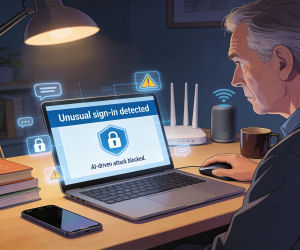
AI now helps criminals do the same thing automatically, and in seconds. It can guess passwords, imitate real users, and even move through systems without being noticed. Some experts call this the “velocity gap”, a fancy way of saying AI moves faster than humans can react.
For home users, that means an attack might unfold before you even realize something’s wrong. Think of it like a thief who can pick every lock in your house at once.
Deepfakes and Fake Voices Are Exploding
You’ve probably heard of deepfakes, fake videos or voices that look or sound like real people. In 2025, these scams jumped by almost 60%. Some use fake IDs or videos to trick banks. Others target individuals through emotional scams. One widely reported case was a Los Angeles woman who lost her life savings to scammers using AI deepfakes of General Hospital star Steve Burton.
 Are you wondering if AI is passing you by while everyone else seems to be racing ahead? “50 Shades of AI” will make AI understandable, usable, and genuinely helpful in the everyday problems you’re already dealing with. Now through Dec 31, you can get it at half price! Use coupon code CYBER50 to download the ebook, and put AI to work in your life.
Imagine getting a voicemail from your “bank” that sounds perfectly real. Or a video call from someone who looks and sounds like your child or grandchild, asking for help. One case involved a Canadian grandma who nearly fell for an AI-generated “grandparent scam” after hearing what sounded like her grandson’s cloned voice claiming he’d been arrested.
Taylor Swift was the most impersonated celebrity worldwide, with deepfake videos and fake ads pushing bogus “limited-edition” merchandise, crypto schemes, and even explicit content targeting her fans. This kind of technology used to require special tools. Now anyone with a laptop can do it.
Identification documents are also being faked. Passports, pay stubs, and driver’s licenses can be recreated in seconds with AI. Criminals use these to open accounts or steal your identity.
Hidden Risks in New Tech
There’s another issue most people don’t think about. The internet itself is changing. A new addressing system called IPv6 is rolling out. It makes more room for devices to connect, computers, TVs, smart doorbells, but it also creates blind spots for security tools.
At the same time, more breaches are coming from third-party companies. You might protect your data well, but what about your security camera app, or smart thermostat maker? And then, there are the careless and clueless. In 2025, about 30% of data breaches came from a vendor or partner company that failed to take basic security precautions. Experts expect that number to double by the end of 2026.
What You Can Do Right Now
You can’t stop AI-driven attacks on your own, but you can make yourself a much harder target. Start with these habits:
- Use strong, unique passwords. Don’t reuse the same one everywhere. A password manager can help you keep track.
- Turn on multi-factor authentication. This adds a second layer of protection, like a code sent to your phone.
- Be careful with messages or calls that seem urgent. If someone asks for money or personal info, verify by calling them back through a trusted number.
- Secure your home devices. Change default passwords on your router and smart gadgets. Keep them updated and on a separate Wi-Fi network if possible.
- Update your software. Many attacks work because people ignore updates. Most updates fix security flaws.
- Don’t trust links and attachments too quickly. If something feels off, it probably is.
- Watch your bank and credit accounts. Turn on alerts so you’ll know the moment something strange happens.
- Share less online. Scammers use what you post to make fake or personalized attacks.
These small steps add up. They'll make it harder for AI tools to use your data or trick you into giving up information. So my advice is to stay smart, not scared. AI itself isn’t evil, it can also help stop attacks and detect fraud. The problem is that both sides are using the same technology.
What matters most is staying vigilant and alert. Criminals will use AI to move faster and hide better, but you can use knowledge to stay ahead. Keep your software updated, question things that don’t feel right, and treat online security like you would locking your doors at night. You can be sure that 2026 will bring new kinds of scams, but the same rule still applies: think before you click, and stay informed.
Do you have something to say about AI, your personal privacy and security? Post your comment or question below...
|
|
|


This article was posted by Bob Rankin on 18 Dec 2025
| For Fun: Buy Bob a Snickers. |
 |
Prev Article: Yes, Your TV is Spying on You (here's how to stop it) |

The Top Twenty |
Next Article: AskBob's Best of 2025 - Part One |
 |
Post your Comments, Questions or Suggestions
|
Free Tech Support -- Ask Bob Rankin Subscribe to AskBobRankin Updates: Free Newsletter Copyright © 2005 - Bob Rankin - All Rights Reserved About Us Privacy Policy RSS/XML |
Article information: AskBobRankin -- AI Will Change Cybercrime in 2026 - Are You Ready? (Posted: 18 Dec 2025)
Source: https://askbobrankin.com/ai_will_change_cybercrime_in_2026_are_you_ready.html
Copyright © 2005 - Bob Rankin - All Rights Reserved
Most recent comments on "AI Will Change Cybercrime in 2026 - Are You Ready?"
Posted by:

Lisa Vandenberghe
18 Dec 2025
I think it will make it worse.
Posted by:

Rich
18 Dec 2025
I have been using Mailwarebytes Premium for years
(paid lifetime) I know you like PCMatic. Will these keep me save if I follow your suggestions>
Posted by:

Ernest N. Wilcox Jr.
18 Dec 2025
In this item, you've suggested nothing new to me, I keep all my computers and other connected devices as up to date as possible, I have my modem/router (provided by my ISP) configured to ignore incoming connection requests, effectively making it and my home Network invisible online, and I always employ/require WPA-2 Wi-Fi security (my hardware doesn't yet support/offer WPA-3) so a pass-code is required to gain access.
Finally, I make it a practice to employ what I call Cognitive Security, which involves remaining constantly skeptical about everything from the Internet, never clicking any hyperlink until I've confirmed that the URL it will take me to denotes the same destination as it's label indicates, and if I can't decipher the URL, I NEVER click it, this goes for links I find anywhere on the Internet, or in email messages. As for email messages, when I receive anything form unfamiliar sources, or that doesn't address me by name, or does so by the wrong name, I delete it. For all other messages, I still never click any hyperlink until I confirm it as stated above. Even for email messages I receive from friends and family, I don't trust anything in them until I confirm that they really do come from the purported sender by making contact by other means (usually with a phone call), and I've given everyone I trust a code word that they put in the message so I know it's authentically trustworthy. Initially, I used unique safe words for each friend and family member, but as my circle grew, that became increasingly difficult, so now I have one word for all of them. Finally I always keep it in mind that everyone and everything I encounter on the Internet is either a stranger until I can properly confirm their identity or produced by strangers. The thing about strangers is that I can't know their true intentions, so until they can convince me otherwise, usually over a significant period of time, I don't trust them or anything they say.
I know that this is a lot, but it has kept me safe on the Internet, and I have no fear while I'm there, so the added effort is well worth what I get back.
I hope this helps others,
Ernie (Oldster)