


Yes, Your TV is Spying on You (here's how to stop it)
Almost every television sold these days is advertised as a Smart TV. Behind the screen, these TVs are computers with an operating system, a hard drive, and Internet connectivity. They also have cameras, a microphone, and sophisticated software that allows them to collect and sell your viewing data. And because they are constantly connected, the same risks (malware and hacking) that apply to computers also apply to smart TVs. Read on to learn about the privacy and security risks of smart TVs, and what you can do to minimize them... |
How to Stop Smart TV Spying
What makes a smart TV smart? When they were first introduced, it was the ability to connect to the Internet, and bring streaming channels and movies to your living room. Later, built-in microphones and cameras added features such as voice commands, hand gestures, and facial recognition, allowing you to control your viewing without so much as picking up the remote.
But both the internet connectivity and those advanced interaction features can be a liability. If a hacker gains access to your connected TV by exploiting a vulnerability, they could use those built-in cameras and microphones to spy on you and your conversations, while you sit transfixed on your couch during a Netflix binge session.
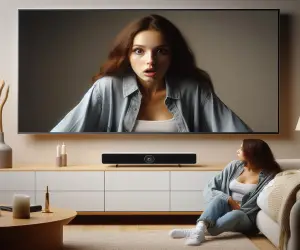
One article I found on this topic said something to the effect that "a bad actor can take control of your television," and do nefarious things like change the channel, or show inappropriate content to children. That made me laugh, and reminded me of the early-1990s Goodtimes Virus spoof. If a hacker gains access to your TV, they won't out themselves by doing something as obvious and stupid as that.
If they hack your smart TV, they could use your Wi-Fi network to gain access to other devices on your home network, such as desktops, laptops, baby monitors, and even your "smart" appliances.
Why do I mention the possibility of your smart TV getting hacked? According to a Wikileaks article from 2017, the CIA was doing exactly that to some Samsung models. That vulnerability has been patched, but you can be sure there are ongoing efforts in this realm.
The larger threat to your privacy comes from within. Smart TV sets use a surveillance technique called Automatic Content Recognition (ACR) to figure out what you're watching. By "watching what you watch," whether it's on streaming services like Netflix, cable, satellite or broadcast TV channels, even DVDs or video games, ACR can identify the content by comparing snippets of onscreen data with a database of known recorded works. If you've ever used Shazam on your phone to identify a song, you can see show this would work on your TV.
ACR does have some legitimate uses. It can be used to identify copyright violations, and also to personalize your viewing. If it can determine what kind of shows you watch, it may be used to recommend similar content. But it exists primarily to collect your viewing data and sell it to data brokers. Your viewing profile is bundled with your IP address, from which your approximate location and socioeconomic status can be determined. You can then be targeted with ads on your TV, smartphone, and desktop computer for products that fit your profile.
A study done by Northeastern University found that many smart TVs sent the ACR data to Amazon, Facebook, and Google. ACR viewing data was also sent to Netflix, even if the service was not present or activated on a set. Targeted ads are common on the Internet. You visit a website selling shoes, and you see ads for shoes. The same is happening as you "surf" the content on your TV screen.
In 2017, TV maker Vizio was fined $2 million by the FTC for selling this data without disclosing the surveillance to customers. Such disclosures are now mandatory. The "permissions" are granted (on an opt-out basis) by the user during setup, and the option to disable data collection is available in the TV settings. But each manufacturer calls it something different, and it can be hard to find the privacy settings. Samsung calls it Viewing Information Services, on Vizio sets it's Viewing Data. LG calls it Live Plus, and Sony has Samba Interactive. Do you think that obfuscation is intentional?
Consumer Reports has instructions for turning off ACR on most major TV brands, including Hisense, Insignia, LG, Philips, Samsung, Sharp, Sony, TCL, Toshiba and Vizio.
Be aware that ACR is not limited to streaming services. It now commonly "watches" everything that appears on your TV screen (that includes inputs from HDMI, DVD and game consoles) and that sampling can be extremely frequent (dozens of times per minute on some sets).
You should also check the privacy settings on any streaming services such as Netflix, Hulu, Amazon Prime, Youtube, Roku. You'll want to check for things like deleting your watch history, ad tracking/personalization options, Data Monitoring settings, and turning off interest-based ads. Login to your account with a web browser, and poke around for "Permissions", "Privacy and Settings", "Data Privacy" or similar headings.
It's a little geeky, but putting your TV and other "connected" devices on your WiFi router’s Guest network can shield you from some of these privacy invasions. See this CNET article on Setting Up Guest Wi-Fi for help with that. Connect the smart TV and other gadgets (smart speakers, smartwatches, fitness trackers, thermostats, smart locks, and video doorbells) to the guest WiFi, leaving PCs, laptops and and phones on your main WiFi network.
What About Those Cameras and Microphones?
Built-in cameras can be used to enable hand gestures to control your TV. LG sets with embedded cameras have supported hand gestures for a decade. Sony's Bravia Cam allows you to use hand signals to pause, adjust volume or turn off the TV. But it will also scold you if you're too close to the screen. Microphones and speech recognition tech allows you to change the channel or search for a show.
As I mentioned earlier, a determined hacker with knowledge of a remotely exploitable vulnerability could use your TV set as a way to watch you. Even if you're not concerned about hackers, do you really need to control your TV by pointing or grunting?
Check the settings to see if these features can be disabled on your TV. Or if you can find the camera on the face of your smart TV, a piece of black tape can be used to cover it.
In closing, here are a few more tips to boost the privacy and security of your smart TV:
- Find out what kinds of data your specific model is collecting, what is done with that data, and how you can limit that. This information should be in your manual, or on the vendor's website. Search online for your TV's model number and the word “privacy.”
- Don’t rely on factory settings. Explore the privacy settings on your set, and change any default passwords if you can.
- Check the manufacturer's website to see if there are any updates or security patches that can be applied.
Your thoughts on this topic are welcome. Are you concerned about your smart TV spying on you? Tell me what think, and what you've done about it. Post your comment or question below...


This article was posted by Bob Rankin on 15 Dec 2025
| For Fun: Buy Bob a Snickers. |
 |
Prev Article: [ALERT] Gadget Insurance and Extended Warranty Scams |

The Top Twenty |
Next Article: AI Will Change Cybercrime in 2026 - Are You Ready? |
 |
Post your Comments, Questions or Suggestions
|
Free Tech Support -- Ask Bob Rankin Subscribe to AskBobRankin Updates: Free Newsletter Copyright © 2005 - Bob Rankin - All Rights Reserved About Us Privacy Policy RSS/XML |
Article information: AskBobRankin -- Yes, Your TV is Spying on You (here's how to stop it) (Posted: 15 Dec 2025)
Source: https://askbobrankin.com/yes_your_tv_is_spying_on_you_heres_how_to_stop_it.html
Copyright © 2005 - Bob Rankin - All Rights Reserved
Most recent comments on "Yes, Your TV is Spying on You (here's how to stop it)"
Posted by:

hifi5000
15 Dec 2025
In the past year, I have stayed in two hotel rooms where there had been smart TVs installed. The smart TVs had the menus where you could select a streamer and if you had an account with them, you could watch your favorite shows on that streamer.
I don't have an account with any of the streamers, so I ended up watching regular broadcast TV. After reading this article, I will have to be careful if I use one of these sets. I haven't realize there are some risks with these TV sets.
Posted by:

CRW
15 Dec 2025
Hmmm, so that "afternoon delight" you just left could have been seen, recorded and the blackmail letter (or email) on its way as we speak.
Posted by:

Frank
16 Dec 2025
V.P. Al Gore did NOT invent the internet.
George Orwell invented the internet in 1984.
Posted by:

Wolf
16 Dec 2025
Another GREAT article! I'm glad that I disabled all of these "smart TV features" after I removed it from the box. With that and so much more going on in society, things are becoming creepier all the time. Yes! We are definitely "moving" into a society, which is becoming more dystopian. I have made the decision that, when my present TV breaks, I will NOT replace it. I'm glad that I don't have any "smart" appliances!
Thank you for the informative article!